Posts

Showing posts with the label Ethics

Philosophical phriday - why take the risk? [LONG]

Image
If, as many security professionals evidently believe, risk concerns the possibility of harm, then surely we ought to do everything possible to reduce the possibility and/or the harm caused, by strengthening and extending security or ideally avoiding it completely by simply not doing risky things - right? OK, so then why do we take risks at all ? Why do we need security to mitigate bad stuff? Security is costly and fallible, so can't we save money by totally avoiding or eliminating risk? Errrrrmmm  ... since it's philosophical phriday, this is an opportunity to explore the issue further, taking a deep dive. But, before I blabber on, dear reader, please take a moment to ponder this for yourself.  No, take several. Take as long as you can. Take the rest of the day off: it's phriday after all. Why do we take risks?  Seriously, why ?   What does it mean to 'take risk'? Grab a pencil or mouse. Jot something down. Think again.  Ponder on. Keep listing, scribbling,...

Directors as kaumātua

Image
The Institute of Directors has just released their Code of Conduct for Directors , promoting six principles: Leading by example. Integrity. Transparency. Accountability. Fairness. Responsible business. So far, so good ... although somehow I feel there's something missing. But what?

Philosophical phriday - dealing with uncertainty

Image
Lately I've been pondering the thought that 'risk' is 'uncertainty' - it's not simply that risky decisions and activities involve some element of doubt, that they might work out extremely well or go horribly wrong, but that the lack of certainty is itself a critical factor. As well as the rational mathematical basis in probability theory and statistics , there is also an emotional aspect to uncertainty. It affects the way we perceive, prepare for and address issues. It affects our planning and capability. It can be debilitating, resulting in indecision and delay even though that may make things even worse: sometimes, it is better to make a decision now (despite the uncertainties) and press ahead in the belief that we will cope with whatever eventuates. Conversely, it may be better to delay a decision and hold back while gathering more information, building resources, preparing and aligning those involved, and considering various eventualities. Uncertainty ha...

Philosophical phriday - a little hype for the weekend

Image
Advertising copy, marketing reports, social media pieces and news articles in general warn us that things are getting worse. Pretty much everything is getting worse, and of course that's bad. See if you recognise any of these choice phrases: In today's [*] world : a classic throwaway AI/MML introductory phrase, presumably emphasising that the present is different to the past, the future dramatically so. With just a short browse through my LinkeDin feed, I've seen the following fill-ins for that asterisk: 'unpredictable', 'complex and uncertain', 'complex business', 'hectic', 'fast-evolving' (paradoxically), 'fast-paced', 'digital', 'fast-paced digital', 'fast-paced hyper-connected', 'fast-paced tech', 'fast-paced data-driven', 'tech-driven', 'mobile-first', 'B2B', 'globalized' (yes, really) blah blah blah. Despite there being 87 synonyms , the robots are c...

Book review: Permanent Record by Ed Snowden

Image
Title: Permanent Record Author: Edward Snowden ISBN: 978-1-250-23723-1 Price: US$18 from Amazon GH rating: 90% Summary Until I read this book, I considered my personal integrity a fundamental strength, core to my very being. It pales in comparison to Ed's extreme courage and intense determination to expose the shocking truth about the NSA's mass surveillance programme and the way it was concealed from Congress.

Measuring and managing ethics

Image
KPMG's Soft Controls model caught my beady eye this week: KPMG are evidently using these 8 factors to analyse, measure and help clients manage their corporate cultures, claiming that "Our model gives organisations a valid tool for getting a clear picture of the current organisational situation, confront it, and break through the silence and passivity." Hmmm, 'silence and passivity', really KPMG? Well OK, whatever. It appears to be a viable approach.

Checklust security

Image
" Seventy Questions to Assess Cybersecurity Risk on a Rapidly Changing Threat Landscape "  is an ISACA 'industry news' article by Patrick Barnett.  Whereas normally I give 'industry news' and checklists a wide berth, Patrick is (according to the article) highly qualified and experienced in the field, so I took  a closer look at this one. The prospect of condensing such a broad topic to a series of questions intrigued me. I'm not totally immune to the gleaming allure of well-conceived checklists. Patrick says: "There are 70 questions that can be asked to determine whether an enterprise has most defensive principles covered and has taken steps to reduce risk (and entropy) associated with cybersecurity. If you can answer “Yes” to the following 70 questions, then you have significantly reduced your cybersecurity risk. Even so, risk still exists, and entropy must be continuously monitored and mitigated. There is no specific number of layers that can remove...

What do auditors do, and for whom? [L O N G]

Image
Once again, my day kicked off with a stimulating and fruitful debate on the ISO27k Forum as members responded to a request for help to find accredited I nformation S ecurity Management S ystem certification auditors who will add value to the organisation above and beyond the ISO/IEC 27001 conformity certificate. The original poster copped some grief from the forum in appearing to seek certification auditors who would be kind on the organisation, supporting its business objectives more strongly than its conformity with the standard ... but a follow-up message clarified the position. Aris confirmed to us that he sought:  "advice on where (in cases of an ISO audit) and how (in cases of an Internal audit) our ISMS could/should be improved, but I need that advice to be meaningful, grounded, and delivered in a way that has the best probability it will be absorbed by the business. In other words, I would like this process to offer real value to the business, besides just bein...

Memories of an O.F.

Image
I freely admit to being an Old Fart, old and plenty farty enough to remember a time even before the DTI Code of Practice was released and then in 1995 became  BS7799 , making information security A Thing. OK so I'm not quite so old as to remember when computers were women in rank and file, studiously calculating missile trajectories, but I've read about them and I remain fascinated by the early mechanical, electro-mechanical and then electronic computers - initially single-purpose tools such as that nice Mr Babbage's difference engine, then machines capable of various tasks using toggle switches, punched tape and cards to program their instructions. Back in the 80's when I escaped the genetics lab to become a net/sysadmin, computer security was just becoming important: people (particularly managers, few of whom had a clue about IT) were vaguely concerned about these new fangled, complicated, mysterious and expensive computers. Securing data processing hardware was seen ...

Using ChatGPT more securely

Image
Clearly there are some substantial risks associated with using AI/ML systems and services, with some serious incidents having already hit the news headlines within a few months of the release of ChatGPT. However, having been thinking carefully and researching this topic for couple of weeks, I realised there are many more risks than the reported incidents might suggest, so  I've written up what I found. This pragmatic guideline explores the information risks associated with AI/ML,  from the perspective of an organisation whose workers are using ChatGPT (as an example) .   Having identified ~26 threats, ~6 vulnerabilities and dozens of possible impactful incident scenarios, I came up with ~20  information security controls capable of mitigating many of the risks. See what you make of it. Feedback welcome. What have I missed? What controls would you suggest? 

Putting policies under pressure

Image
A note on LinkeDin led me to an intriguing scientific research study that tested the following five hypotheses: People who receive instructions via a written policy about rules will have better knowledge of these rules than those that do not.  People who receive a shorter form version of policy about the rules with less text will have better knowledge of the rules than those who receive a longer training form.  People who receive a written policy outlining the rules in a more vernacular and less legal technical language will have better knowledge of the rules than those presented with a more formal-legal-styled training text.  People with better knowledge of rules will also comply more with such rules. The more legal rules align with people’s personal and social norms, the higher people score in their knowledge of these legal rules.  

Ten tips on tackling a thorny infosec issue

Image
A member approached the  ISO27k Forum   this morning for advice: " What would you recommend to do if our warnings as ISMS department specialists/auditors are not taken into account?" What can realistically be done if  management isn't paying sufficient attention to information risks that we believe are significant ?  This is a thorny issue and not an uncommon challenge, particularly among relatively inexperienced or naïve but eager information risk and security professionals, fresh out of college and still studying hard for their credentials. It can also afflict the greybeards among us: our passion for knocking down information risks can overtake our abilities to convince managers and clients. Here are ten possible responses to consider: 

Responsible disclosure - another new policy

Image
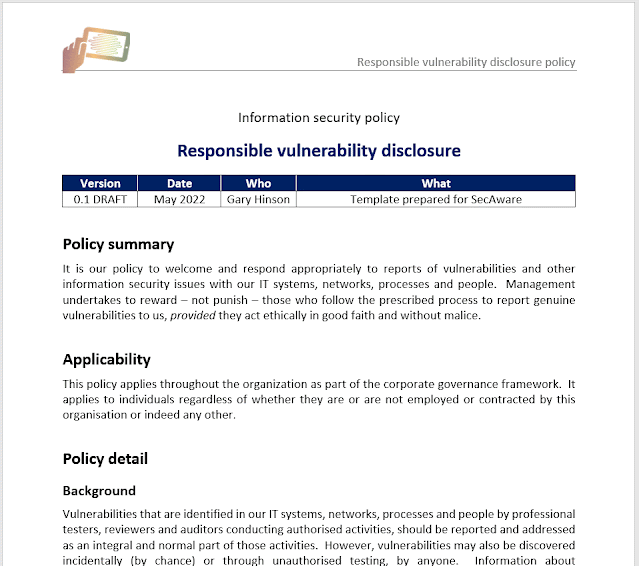
We have just completed and released another topic-specific information security policy template, covering responsible disclosure (of vulnerabilities, mostly). The policy encourages people to report any vulnerabilities or other information security issues they discover with the organisation's IT systems, networks, processes and people. Management undertakes to investigate and address reports using a risk-based approach, reducing the time and effort required for spurious or trivial issues, while ensuring that more significant matters are prioritised. The policy distinguishes authorised from unauthorised security testing, and touches on ethical aspects such as hacking and premature disclosure. It allows for reports to be made or escalated to Internal Audit, acting as a trustworthy, independent function, competent to undertake investigations dispassionately. This is a relief-valve for potentially sensitive or troublesome reports where the reporter is dubious of receiving fair, prompt t...

Managing professional services engagements

Image
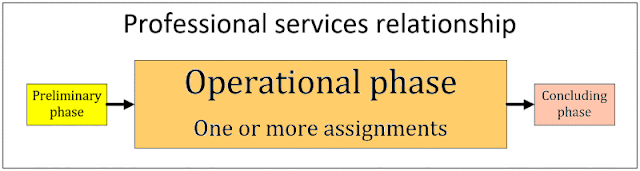
In relation to professional services, management responsibilities are shared between client and provider, except where their interests and concerns diverge. Identifying and exploiting common interests goes beyond the commercial/financial arrangements , involving different levels and types of management: Strategic management: whereas some professional services may be seen as short-term point solutions to specific issues ("temping"), many have longer-term implications such as the prospect of repeat/future business if things work out so well that the engagement is clearly productive and beneficial to both parties. Establishing semi-permanent insourcing and outsourcing arrangements can involve substantial investments and risks with strategic implications, hence senior management should be involved in considering and deciding between various options, designing and instituting the appropriate governance and management arrangements, clarifying responsibilities and accountabilities...

Professional services - concluding phase

Image
Having introduced this blog series and covered information risks applicable to the preliminary and operational phases of a professional services engagement, it's time to cover the third and final phase when the engagement and business relationship comes to an end. Eventually, all relationships draw to a close. Professional services clients and providers go their separate ways, hopefully parting on good terms unless there were unresolved disagreements, issues or incidents (hinting at some information risks). It is worth considering what will/might happen at the end of a professional services engagement as early as the preliminary pre-contract phase. Some of the controls need to be predetermined and pre-agreed in order to avoid or mitigate potentially serious risks later-on. Straightforward in principle ... and yet easily neglected in the heady rush of getting the engagement going. This is not unlike a couple drawing up their "pre-nup" before a wedding, or a sensible organi...