Posts

Showing posts with the label IT

Throwback Thursday - koalas and magnetographics

Image
This week, I'm thoroughly engrossed by a deep dive into ISO/IEC 2382, a suite of standards on IT terminology from the 1990's around the end of the previous millennium - ancient history as far as IT goes. "ISO 2382 was initially based mainly on the usage to be found in the Vocabulary of Information Processing which was established and published by the International Federation for Information Processing and the International Computation Centre, and in the American National Dictionary for Information Processing Systems and its earlier editions published by the American National Standards Institute (formerly known as the American Standards Association). Published and Draft International Standards relating to information technology of other international organizations (such as the International Telecommunication Union and the International Electrotechnical Commission) as well as published and draft national standards have also been considered." I say "IT" but it...

Philosophical phriday - recovering from ransomware takes HOW long?!

Image
Recovering from a ransomware incident is costlier, more complicated and much slower that people commonly assume. "Just restore the backups and you're good to go, right?". Spoiler alert: restoring networks and IT systems from backups is only a fraction of this.  Here's a reasonably complete set of ransomware recovery activities that would normally led by general business and IT managers : Wake up and smell the coffee! Deal with the unfolding crisis and a degree of confusion. Invoke the crisis management process. Settle things down. Assemble the business incident management team. Invoke the incident management process. Form the IT incident management team. Contact insurers, law enforcement and security experts for guidance.

Define: ironic

Image
 

Cognitive Hack - book review

Image
Title: Cognitive Hack - The New Battleground in Cybersecurity... The Human Mind Author: James Bone Part of the Internal Audit  and IT Audit series edited by Dan Swanson Publisher: CRC Press/Auerbach (2017) ISBN: 978-1-4987-4981-7 Price: US $100 ( hardback ) US $53 ( paperback ) GH rating: 50% Summary The author's core thesis is that we are expecting IT users and managers to make rational, risk-averse decisions and take appropriate actions in response to complex threats. The 'cognitive load' is such that people are bound to make mistakes. Therefore we  should be simplifying things ( e.g. by automating cybersecurity controls), thereby reducing the number of choices and hence taxing decisions we're asking people to make.

Crowdstrike - a para-incident review

Image
We find ourselves in the midst of a classic social response to a significant incident - a heady blend of technobabble, confusion and hyperbole, with a sprinkling of genuinely helpful information, grief and support for those right in the thick of it, and warnings about the likelihood of further exploitation ... of ... the classic social response to a significant incident.  That's a positive feedback loop, amplified by the echo chambers of social media, and traditional news reporters whose job is (in part) to stir the pot and sell papers. "This is HUGE !" they tell us, breathlessly. "Bigger than a really big thing, and still growing!"  According to the din just on LinkeDin over the weekend, the Crowdstrike incident is "a major global outage", a " mass global outage and major impact to services",  "carnage", "cataclysmic", "global chaos", the "patchpocalypse", "digital catastrophe", "the bi...

A nightmare on DR street

Image
A provocative piece on LinkeDin by Brian Matsinger caught my beady eye and sparked my fertile imagination today. I'm presently busy amplifying the disaster recovery advice in NIS 2 for a client. When I say 'amplifying', I mean generating an entire awareness and training piece on the back of a single mention of 'disaster recovery' in all of NIS 2. Just the one. Blink and you'll miss it. Oh boy. Anyway, Brian points out that recovering from disasters caused by 'cyber attacks' requires a different DR approach than is usual for physical disasters such as storms, fires and floods. Traditional basic DR plans are pretty straightforward: essentially, the plans tell us to grab recent backups and pristine systems, restore the backups onto said systems, do a cursory check then release services to users. Job's a good 'un, off to the pub lads.

Checklust security

Image
" Seventy Questions to Assess Cybersecurity Risk on a Rapidly Changing Threat Landscape "  is an ISACA 'industry news' article by Patrick Barnett.  Whereas normally I give 'industry news' and checklists a wide berth, Patrick is (according to the article) highly qualified and experienced in the field, so I took  a closer look at this one. The prospect of condensing such a broad topic to a series of questions intrigued me. I'm not totally immune to the gleaming allure of well-conceived checklists. Patrick says: "There are 70 questions that can be asked to determine whether an enterprise has most defensive principles covered and has taken steps to reduce risk (and entropy) associated with cybersecurity. If you can answer “Yes” to the following 70 questions, then you have significantly reduced your cybersecurity risk. Even so, risk still exists, and entropy must be continuously monitored and mitigated. There is no specific number of layers that can remove...

eWaste safety hazards and information risks

Image
A warning in the New Zealand Information Security Manual  caught my beady eye yesterday: “Electrical and electronic equipment contains a complex mix of materials, components and substances, many which can be poisonous, carcinogenic or toxic in particulate or dust form. Destruction and disposal of WEEE [Waste from Electrical and Electronic Equipment] needs to be managed carefully to avoid the potential of serious health risk or environmental hazard.” Disposing of eWaste presents environmental and safety hazards arising from noxious/toxic/carcinogenic chemicals such as gallium arsenide (GaAs) and polychlorinated biphenyls (PCBs), plus the obvious dangers when handling sharp-edged metal or plastic chassis fragments, wires, printed circuit boards and CD/DVD discs plus  leaky electrolytic capacitors and old batteries . While there may be money to be made by extracting and recycling valuable metals  and reusable components ,  subsystems and modules , that's really a jo...

Memories of an O.F.

Image
I freely admit to being an Old Fart, old and plenty farty enough to remember a time even before the DTI Code of Practice was released and then in 1995 became  BS7799 , making information security A Thing. OK so I'm not quite so old as to remember when computers were women in rank and file, studiously calculating missile trajectories, but I've read about them and I remain fascinated by the early mechanical, electro-mechanical and then electronic computers - initially single-purpose tools such as that nice Mr Babbage's difference engine, then machines capable of various tasks using toggle switches, punched tape and cards to program their instructions. Back in the 80's when I escaped the genetics lab to become a net/sysadmin, computer security was just becoming important: people (particularly managers, few of whom had a clue about IT) were vaguely concerned about these new fangled, complicated, mysterious and expensive computers. Securing data processing hardware was seen ...

Hinson tip on ChatGPT

Image
When using ChatGPT and its ilk, d on't forget that the AI robot's contribution  is generic and not necessarily smart, accurate, sufficient or appropriate, despite the beguiling use of language that makes it  appear  logical, credible and reasonable at face value ... but is it, really? Or is it short on integrity? When, for instance, a real-world client reads a human expert advisor's report or consultant's recommendation, they are generally: Thinking critically about it, c onsidering what is and what is not stated and how it is expressed; Posing additional questions for clarity ( e.g. "On what basis do you believe we can achieve all that in 8 months, given that there's only one of me and I'm stretched thin as steam-rollered chewing gum?") or credibility ("How long did your last client take for this?") and perhaps a rguing the toss ("8 months? You're kidding, right? We only have 4!"); Taking advantage of knowledge and experience w...

To what extent do you trust the robots?

Image
This Sunday morning, fueled by two strong coffees, I'm cogitating on the issue of workers thoughtlessly disclosing all manner of sensitive personal or proprietary information in their queries to AI/ML/LLM systems and services run by third parties, such as ChatGPT. This is clearly topical given : (1) the deluge of publicity and chatter around ChatGPT right now, coupled with  (2) our natural human curiosity to explore new tech toys, plus  (3) limited appreciation of the associated information risks, and  (4) the rarity of controls such as policies and Data Leakage Protection technologies.  Furthermore, even if we do persuade our colleagues (and, let's be honest, ourselves!) to be more careful and circumspect about whatever we are typing or pasting into various online systems, the possibility remains that the general nature of our interests and queries is often sensitive.

The power of power measurement

Image
Electrical power consumption by a computer cupboard, IT room, tech suite, data centre or facility  is one of my favourite [pet!] metrics   for several reasons: It is readily measured using a wattmeter, watt-hour meter or ammeter on the main supply line/s; Compared to more technical metrics, power is simple to plot, report, explain and understand; As the installed IT equipment and usage gradually changes, so does the power consumption. It is straightforward to track and predict the overall trends without necessarily measuring and controlling every single item and change;  Step changes in power consumption indicate substantial changes in the IT equipment or usage. Marked decreases are welcome but quite rare ( e.g . as older equipment is retired from service or replaced by more modern, energy-efficient stuff), whereas marked increases in consumption - especially if unexpected - may be cause for concern; The first law of thermodynamics tells us that all the input energy has t...

Complete security is an oxymoron

Image
An interesting Kiwi business startup caught my beady eye today. Without being too specific, they are offering a financial service, making me curious about the legal and regulatory hoops they presumably had to clear in order to do so . Checking their shiny new website hasn't exactly inspired me with confidence. The home page claims to be using a completely secure platform ... which is, I suspect, a bit of a porky, an exaggeration, stretching the truth. Maybe they have been carried away by their own marketing. Perhaps they are just naive. I have never come across a totally secure system, and seriously doubt there is such a beast. Sure, I've dealt with many highly secure systems, all of which were vulnerable in various ways. None of the organisations concerned had the nerve to claim they were totally secure however, since (with a little guidance from pro's like me!) management accepted that there were residual risks, despite all our efforts.  Paradoxically, by claiming total s...

Webserver problem problem

Image
This cold Winter's Monday morning, we woke to problems accessing our server and websites. The usual turnitoffandonagain approach let us down ... and this time so has downforeveryoneorjustme dotcom: It's ironic that a web service purely designed to tell us if a website is working is, itself, at least partially unresponsive - a broken control. It doesn't even say what or where the problem might be, remaining stubbornly stuck at "Checking server. Please wait ..." Ping and tracert indicate the server is still sitting pretty on its Internet perch, so my guess is something bizarre going on with the webserver, possibly an attack in progress but more likely a simple config problem somewhere along the long, long chain of links and systems between us and the server, maybe even the DNS. This is embarrssing given my professional interests, a bad start to the week but our incident management team is on the case, tooling-up as I speak. So what can I say? Normal service will b...

Security in software development

Image
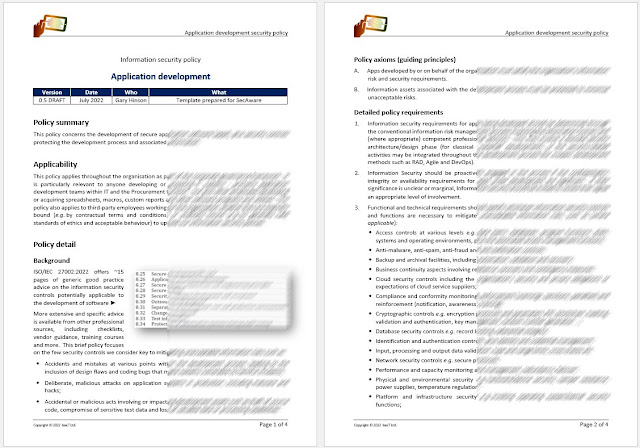
Prompted by some valuable customer feedback earlier this week, I've been thinking about how best to update the SecAware policy template on software/systems development. The customer is apparently seeking guidance on integrating infosec into the development process, which begs the question "Which development process?". These days, we're spoilt for choice with quite a variety of methods and approaches.  Reducing the problem to its fundamentals, there is a desire to end up with software/systems that are 'adequately secure', meaning no unacceptable information risks remain. That implies having systematically identified and evaluated the information risks at some earlier point, and treated them appropriately - but how? The traditional waterfall development method works sequentially from business analysis and requirements definition, through design and development, to testing and release - often many months later. Systems security ought to be an integral part of th...