Posts

Showing posts with the label Network

Throwback Thursday - koalas and magnetographics

Image
This week, I'm thoroughly engrossed by a deep dive into ISO/IEC 2382, a suite of standards on IT terminology from the 1990's around the end of the previous millennium - ancient history as far as IT goes. "ISO 2382 was initially based mainly on the usage to be found in the Vocabulary of Information Processing which was established and published by the International Federation for Information Processing and the International Computation Centre, and in the American National Dictionary for Information Processing Systems and its earlier editions published by the American National Standards Institute (formerly known as the American Standards Association). Published and Draft International Standards relating to information technology of other international organizations (such as the International Telecommunication Union and the International Electrotechnical Commission) as well as published and draft national standards have also been considered." I say "IT" but it...

Philosophical phriday - recovering from ransomware takes HOW long?!

Image
Recovering from a ransomware incident is costlier, more complicated and much slower that people commonly assume. "Just restore the backups and you're good to go, right?". Spoiler alert: restoring networks and IT systems from backups is only a fraction of this.  Here's a reasonably complete set of ransomware recovery activities that would normally led by general business and IT managers : Wake up and smell the coffee! Deal with the unfolding crisis and a degree of confusion. Invoke the crisis management process. Settle things down. Assemble the business incident management team. Invoke the incident management process. Form the IT incident management team. Contact insurers, law enforcement and security experts for guidance.

A nightmare on DR street

Image
A provocative piece on LinkeDin by Brian Matsinger caught my beady eye and sparked my fertile imagination today. I'm presently busy amplifying the disaster recovery advice in NIS 2 for a client. When I say 'amplifying', I mean generating an entire awareness and training piece on the back of a single mention of 'disaster recovery' in all of NIS 2. Just the one. Blink and you'll miss it. Oh boy. Anyway, Brian points out that recovering from disasters caused by 'cyber attacks' requires a different DR approach than is usual for physical disasters such as storms, fires and floods. Traditional basic DR plans are pretty straightforward: essentially, the plans tell us to grab recent backups and pristine systems, restore the backups onto said systems, do a cursory check then release services to users. Job's a good 'un, off to the pub lads.

Checklust security

Image
" Seventy Questions to Assess Cybersecurity Risk on a Rapidly Changing Threat Landscape "  is an ISACA 'industry news' article by Patrick Barnett.  Whereas normally I give 'industry news' and checklists a wide berth, Patrick is (according to the article) highly qualified and experienced in the field, so I took  a closer look at this one. The prospect of condensing such a broad topic to a series of questions intrigued me. I'm not totally immune to the gleaming allure of well-conceived checklists. Patrick says: "There are 70 questions that can be asked to determine whether an enterprise has most defensive principles covered and has taken steps to reduce risk (and entropy) associated with cybersecurity. If you can answer “Yes” to the following 70 questions, then you have significantly reduced your cybersecurity risk. Even so, risk still exists, and entropy must be continuously monitored and mitigated. There is no specific number of layers that can remove...

Internet security guidance

Image
The second edition of ISO/IEC 27032 "Cybersecurity - Guidelines for Internet security" has just been published. The introduction to the new edition commences: "The focus of this document is to address Internet security issues and provide guidance for addressing  common Internet security threats, such as: — social engineering attacks; — zero-day attacks; — privacy attacks; — hacking; and — the proliferation of malicious software (malware), spyware and other potentially unwanted  software." Notice the standard is focused on " Internet security issues " which, in practice, means it covers active attacks perpetrated via the Internet. However:

Order from chaos from order

Image
Towards the end of last year, I wrote a series of blog entries expanding on 20 terms of art, mostly for fun, partly for education, and partly as an exercise in creative thinking ... and today I'm doing it again. As a recap, here are the original 20: Accountability  is ... Assurance  is ... Audit  is ... Authorisation  is ... Control  is ... Cyber  is ... Fragility  is ... Governance  is ... Impact  is ... Information  is ... ISO27k  is ... Oversight  is ... Resilience  is ... Responsibility  is ... Risk  is ... Security  is ... System is ... Threat  is ... Trust  is ... Vulnerability  is ... Today, I'm nose-to-the-grindstone, writing my book on information risk management, doing my best to 'tell a good story'. I'm trying to make sense of the jumble of concepts and thoughts in my head, hopefully expressing things clearly enough for readers to understand and be inspired to think and do things di...

A round dozen risk treatment options

Image
I've been thinking about the 'treatment' phase of risk management lately. These are the four conventional and generally-accepted ways of treating (addressing) identified risks: Acceptance : living with the risk, hoping that it doesn't materialise; Avoidance : steering well clear of, or stopping, risky activities; Mitigation : reducing the probability and/or impact of incidents using various types of control;   Sharing : with others, such as business partners, insurers and communities. However, it occurs to me that a further eight risk treatment approaches are possible, whether you consider them alternatives, variants or complementary: Procrastination : delaying decisions and actions ostensibly in order to understand risks and possible treatment options (which, meanwhile, implies risk acceptance). Speedy decision-making is an important part of effective

BCM for WFH

Image
Since home and mobile workers rely on IT to access critical business systems and corporate data, and to communicate with others, organisations need a robust IT network infrastructure that extends to workers' homes or wherever they hang out. If, in reality, the infrastructure turns out to be fragile and unreliable, business activities are likely to be equally fragile and unreliable, leading to frustration and grief all round. In other words, the extended IT infrastructure is quite likely business-critical. W orking F rom H ome or on the road can increase various information risks relative to conventional office-based work, due to factors such as: Use of cloud computing services*; Workers using their own or shared devices and internet connections for work purposes, raising questions about their suitability and security, ownership of and access to any intellectual property or personal information on them;

To what extent do you trust the robots?

Image
This Sunday morning, fueled by two strong coffees, I'm cogitating on the issue of workers thoughtlessly disclosing all manner of sensitive personal or proprietary information in their queries to AI/ML/LLM systems and services run by third parties, such as ChatGPT. This is clearly topical given : (1) the deluge of publicity and chatter around ChatGPT right now, coupled with  (2) our natural human curiosity to explore new tech toys, plus  (3) limited appreciation of the associated information risks, and  (4) the rarity of controls such as policies and Data Leakage Protection technologies.  Furthermore, even if we do persuade our colleagues (and, let's be honest, ourselves!) to be more careful and circumspect about whatever we are typing or pasting into various online systems, the possibility remains that the general nature of our interests and queries is often sensitive.

2 more topic-specific information security policies

Image
We have just completed and released another two information security policy templates through SecAware.com . The latest additions are security policy templates on: APIs ( A pplication P rogramming I nterfaces) and microservices , used as building blocks to construct compound applications; DNS ( D omain N ame S ervice) , used to associate domain names with Internet server IP addresses. The full SecAware policy suite now has 83 templates: They were all researched and written to a consistently high quality, by me. They are designed to mesh together, complementing each other. I maintain them, updating individual policies as and when required and reviewing the entire suite every year or so.  We provide them as MS Word documents that you can easily customise.  Get in touch for additional policies, procedures or guidelines, or if you need assistance to adapt them to your corporate style.  Buy them individually for $20 or take the whole lot for $399, saving over $1200.

Two dozen data centre fire controls

Image
Fire is clearly a significant risk to any data centre given that  a major incident (disaster!) is reported globally roughly every quarter year on average  plus an unknown number of smaller/unreported ones. Limited public disclosure of data centre fire investigation reports makes it tough, even for experienced professionals , to assess and quantify the risk.  However, s ince the likely impacts and costs of such major incidents are obviously non-trivial and the number of incidents is definitely not zero, it would be negligent to ignore the risks. Controls to avoid, mitigate or share data centre/IT facility fire risks include: Governance and management arrangements taking due account of information risks including physical security aspects when designing and procuring information services such as commercial cloud services and data centre/co-location facilities - which, by the way, don't automatically reduce

Skyscraper of cards

Image
Having put it off for far too long, I'm belatedly trying to catch up with some standards work in the area of R oot o f T rust, which for me meant starting with the basics, studying simple introductory articles about RoT. As far as I can tell so far, RoT is a concept -  the logical basis, the foundation on which secure IT systems are built. 'Secure IT systems' covers a huge range. At the high end are those used for national security and defence purposes, plus safety- and business-critical systems facing enormous risks (substantial threats and impacts). At the low end are systems where the threats are mostly accidental and the impacts negligible - perhaps mildly annoying. Not being able to tell precisely how many steps you've taken today, or being unable to read this blog, is hardly going to stop the Earth spinning on its axis. In fact' mildly' may be overstating it. 'Systems' may be servers, desktops, portables and wearables, plus IoT things and all mann...

ISO/IEC 27400 IoT security and privacy standard published

Image
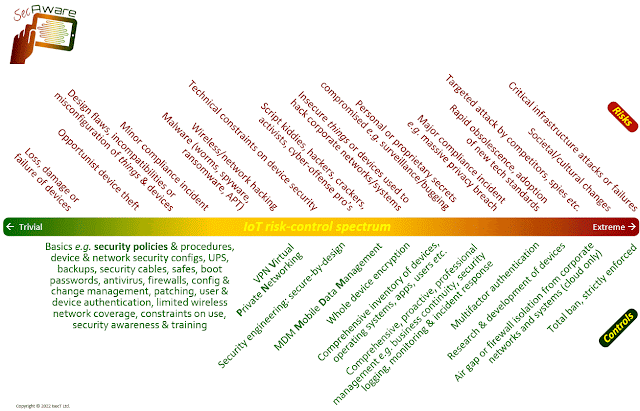
To celebrate the publication of ISO/IEC 27400:2022 today, we have slashed the price for our IoT security policy templates to just $10 each through SecAware.com. IoT policy is the first of the basic security controls shown on the 'risk-control spectrum' diagram above, and is Control-01 in the new standard ... Do you have a security policy on IoT? If not, does that mean IoT is out of control in your organisation? Even if you do, what does it say? Is it valid, appropriate, worthwhile, sufficient?   The spectrum diagram shows quite a variety of risks and controls, but it is merely a summary, selected highlights. Attempting to cover them all in a policy document would be counterproductive - in fact, general employees can barely cope with a much-simplified one-page 'acceptable use policy'.   The new ISO/IEC 27400 standard takes a broad perspective with copious advice on information security and privacy for the designers, manufacturers, purchasers, users and administrators o...

Domotics - a can-o-worms

Image
This morning, I’ve been browsing and thinking about ISO/IEC 27403 , a draft ISO27k standard on the infosec and privacy aspects of “domotics” i.e. IoT things at home.   Compared to a [reasonably well controlled] corporate situation, there are numerous ‘challenges’ (risks) in the home setting e.g.: Limited information security awareness and competence by most people. IoT things are generally just black-boxes. Ad hoc assemblages of networked IT systems - including things worn/carried about the person (residents and visitors) and work things, not just things physically installed about the home (e.g. smart heating controls, door locks and cat feeders). Things are not [always] designed for adequate security or privacy since other requirements (such as low price and ease of use) generally take precedence. Finite processing and storage capacities, plus limited user interfaces, hamper/constrain their security capabilities. Lack of processes for mana...

Weaving strategies with policies

Image
I mentioned recently here on the blog that there can be strategic elements to policies, just as there are operational aspects to the supporting procedures and guidelines. With the new year fast approaching, I'd like to explore that further today. Warning : your blinkers are coming off. Prepare for the glare. Take for instance the corporate responses to COVID-19. Out of necessity, organisations in lockdown shifted rapidly from on-site office work and in-person meetings to home-working, using video conferencing, email and collaborative approaches. Although that may have been a purely reactive, un-pre-planned response to the global crisis that erupted (despite prior pandemics and warnings arising from increasing international travel) , it was facilitated by longer-term planned, strategic changes and investments in a resilient workforce with flexible working practices and positive attitudes, strong relationships within and without the organisation, plus appropriate tools and technolog...