Posts

Showing posts with the label Fraud

Accreditation vs certification

Image
First, two definitions: " Certification " is the process of checking something against defined criteria, and if it passes (meets the criteria), issuing a certificate of compliance or conformity or assurance or whatever. Certification gives some assurance that the certified organisation or individual meets the criteria ... provided the certification body or person is competent and trustworthy, the checks were done properly, and the certificate itself is authentic. Hmmm, quite a few caveats there ... " Accreditation " is the process of confirming that whoever is checking and issuing certificates is properly qualified, competent and trusted to issue meaningful certificates by following prescribed processes. It adds credibility, meaning and value to the certification and issued certificates ... provided the accreditation body or person is competent and trustworthy, the checks were done properly, and the a...

BCM for WFH

Image
Since home and mobile workers rely on IT to access critical business systems and corporate data, and to communicate with others, organisations need a robust IT network infrastructure that extends to workers' homes or wherever they hang out. If, in reality, the infrastructure turns out to be fragile and unreliable, business activities are likely to be equally fragile and unreliable, leading to frustration and grief all round. In other words, the extended IT infrastructure is quite likely business-critical. W orking F rom H ome or on the road can increase various information risks relative to conventional office-based work, due to factors such as: Use of cloud computing services*; Workers using their own or shared devices and internet connections for work purposes, raising questions about their suitability and security, ownership of and access to any intellectual property or personal information on them;

Novel insider threat

Image
A post on LinkeDin this morning led me to a news piece  about an IT professional's attempt to divert/steal his employer's payoffs for a ransomware infection, back in 2018. According to the article, his attempt ultimately failed, largely due to his inept and naive execution ... but I have not come across this particular insider threat before. It was a new one on me, a man-in-the-middle attack layered on top of the ransomware.

eWaste safety hazards and information risks

Image
A warning in the New Zealand Information Security Manual  caught my beady eye yesterday: “Electrical and electronic equipment contains a complex mix of materials, components and substances, many which can be poisonous, carcinogenic or toxic in particulate or dust form. Destruction and disposal of WEEE [Waste from Electrical and Electronic Equipment] needs to be managed carefully to avoid the potential of serious health risk or environmental hazard.” Disposing of eWaste presents environmental and safety hazards arising from noxious/toxic/carcinogenic chemicals such as gallium arsenide (GaAs) and polychlorinated biphenyls (PCBs), plus the obvious dangers when handling sharp-edged metal or plastic chassis fragments, wires, printed circuit boards and CD/DVD discs plus  leaky electrolytic capacitors and old batteries . While there may be money to be made by extracting and recycling valuable metals  and reusable components ,  subsystems and modules , that's really a jo...

Using ChatGPT more securely

Image
Clearly there are some substantial risks associated with using AI/ML systems and services, with some serious incidents having already hit the news headlines within a few months of the release of ChatGPT. However, having been thinking carefully and researching this topic for couple of weeks, I realised there are many more risks than the reported incidents might suggest, so  I've written up what I found. This pragmatic guideline explores the information risks associated with AI/ML,  from the perspective of an organisation whose workers are using ChatGPT (as an example) .   Having identified ~26 threats, ~6 vulnerabilities and dozens of possible impactful incident scenarios, I came up with ~20  information security controls capable of mitigating many of the risks. See what you make of it. Feedback welcome. What have I missed? What controls would you suggest? 

The discomfort zone

Image
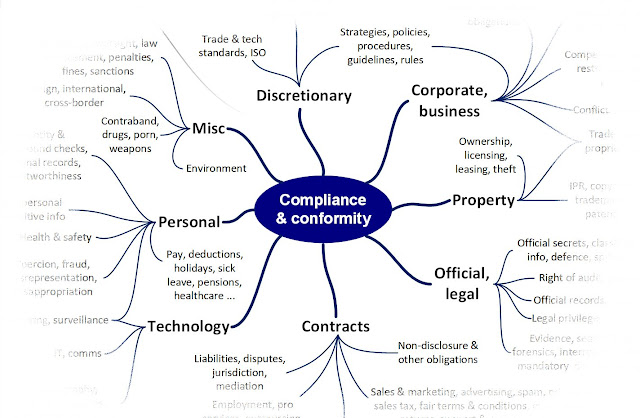
Compliance is a concern that pops up repeatedly on the ISO27k Forum , just this  morning for instance. Intrigued by ISO 27001 Annex A control A.18.1.1 "Identification of applicable legislation and contractual requirements", members generally ask what laws are relevant to the ISMS.  That's a tough one to answer for two reasons.   Firstly, I'm not a lawyer so I am unqualified and unable to offer legal advice. To be honest, I'm barely familiar with the laws and regs in the UK/EU and NZ, having lived and worked here for long enough to absorb a little knowledge. The best I can offer is a layman's perspective. I feel more confident about the underlying generic principles of risk, compliance, conformity, obligations, accountabilities, assurance and controls though, and have the breadth of work and life experience to appreciate the next point ... Secondly, there is a huge range of laws and regs that have some relevance to information risk, security, management and t...

Responsible disclosure - another new policy

Image
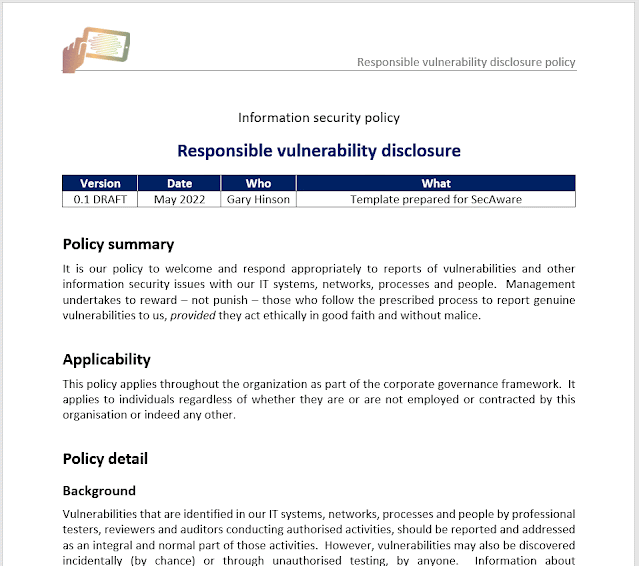
We have just completed and released another topic-specific information security policy template, covering responsible disclosure (of vulnerabilities, mostly). The policy encourages people to report any vulnerabilities or other information security issues they discover with the organisation's IT systems, networks, processes and people. Management undertakes to investigate and address reports using a risk-based approach, reducing the time and effort required for spurious or trivial issues, while ensuring that more significant matters are prioritised. The policy distinguishes authorised from unauthorised security testing, and touches on ethical aspects such as hacking and premature disclosure. It allows for reports to be made or escalated to Internal Audit, acting as a trustworthy, independent function, competent to undertake investigations dispassionately. This is a relief-valve for potentially sensitive or troublesome reports where the reporter is dubious of receiving fair, prompt t...

Professional services infosec policy template

Image
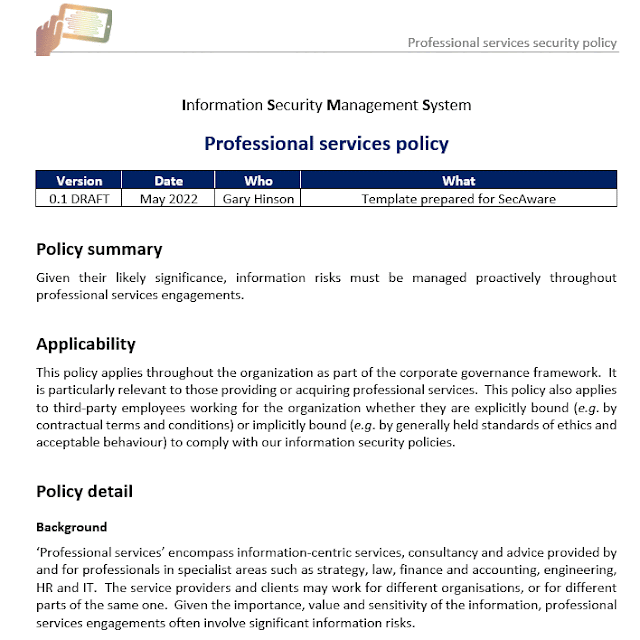
  We have just completed and released a brand new information security policy template on professional services. The policy is generic, pragmatic and yet succinct at just over 2 pages. Professional services engagements, and hence the associated information risks, are so diverse that it made no sense to specify particular infosec controls, except a few examples. Instead, the policy requires management to nominate Information Owners for each professional services engagement, and they, in turn, are required to identify, evaluate and treat the information risks. This is another shining example of the value of the 'information ownership' concept. Although they are encouraged to delegate responsibilities to, or at least take advice from, relevant, competent experts (e.g. in Information Risk and Security, Legal/Compliance, HR, IT, Procurement), Information Owners are held personally accountable for the protection and legitimate exploitation of 'their' information. If Informati...

Google customers phishing

Image
We're seeing a steady stream of 'update your email'-type crude phishers along these lines: I have lightly redacted the URL, but those action buttons are clearly not  pointing to an IsecT domain.   Firebase Storage is a Google cloud storage/app service: Google promotes Firebase security in terms of high availability and authentication for their customers i.e. web developers using Firebase to host content on the web. No mention of security for their customers' victims though and although Google can't be held entirely responsible for its customers' nefarious activities, I presume (hope!) they have the processes in place to identify and respond efficiently to incidents of this nature. I've reported this incident through a Firebase customer support channel as there is no obvious way for us to report misuse of their services by phishers etc. I'll let you know how they respond. PS  They didn't.  Harrumph.

An interesting risk metric

Image
We were chatting over coffee  t his morning about an organisation that is recruiting at the moment. Having been through the cycle of advertising, preselecting/long-listing, interviewing and short-listing candidates, their references came back negative, forcing the organisation to reboot the recruitment process. On the one hand, that's a disappointing and somewhat costly outcome. It suggests, perhaps, that the preselection and interviewing steps could be tightened up. Were there warning signs - yellow or red flags that could/should have been spotted earlier in the process? On the other, it also indicates that the selection/recruitment process is effectively identifying and weeding-out unsuitable applicants, avoiding what could have turned out to be even costlier incidents down the line if the appointments had been made and the new recruits had turned out to be unsuitable. So, Proportion of shortlisted candidates rejected as a result of poor references  is one of several possibl...

Things an ISO27k SoA doesn't say

Image
According to ISO/IEC 27001:2013 , organisations are supposed to consider all the information security controls outlined in Annex A, confirming that they have done so by preparing a S tatement o f A pplicability "that contains the necessary controls .... and justification for inclusions, [states] whether they are implemented or not, and [gives] the justification for exclusions of controls from Annex A". That ineptly-worded requirement in a poorly-constructed and in fact self-contradictory clause of the standard is generally interpreted, in practice, in the form of an SoA table with a row for every Annex A control* and columns for applicability, justifications and implementation status of each control*. Three exclusive states are generally used.  Each control* is one of: Applicable and implemented; Applicable but not implemented; or Not applicable. ... implying a simple decision tree with just two binary questions:   First, is the control* applicable (yes or no)? If the con...

Phishing evolution

Image
The Interweb drums have been beating out news of an upsurge in phishing attacks over the past month or so. I’ve certainly had more than the normal number of things along these lines lately:     As usual, these are relatively crude and (for most reasonably alert people) easy to spot thanks to the obvious spelling and grammatical errors, often using spurious technobabble and urgency as well as the fake branding and sender email address in an attempt to trick victims.   The ‘blocked emails’ and ‘storage limit’ memes are popular in my spam box right now, suggesting that these are basic phishing-as-a-service or phishing-kit products being used by idiots to lure, hook, land and gut other idiots.   They are, however, using my first name in place of “Dear subscriber” or “Hello, how are you doing?” that we used to see, implying the use of mailmerge-type content customisation with databases of email addresses and other info on potential victims*. Moving up the scale, some curr...

March 13 - COVID-19 information risk analysis

Image
I'll kick off with a disclaimer: IANAV*. I have a scientific background in microbial genetics but left the field more than 3 decades ago. I have far more experience in information risk management, so what follows is my personal assessment of the information risks ('risks pertaining to information') associated with the Coronavirus pandemic . Here's my initial draft of a  P robability- I mpact- G raphic showing what I see as the main information risk aspects right now, today, with a few words of explanation below: Top left, the reported shortages of toilet rolls, facemasks, hand sanitiser and soap qualify as information incidents because they are the result of panic buying by people over-reacting to initial media coverage of shortages. The impacts are low because most people are just not that daft.  F ear, U ncertainty and D oubt, however, is largely what drives those panic buyers. To an extent, I blame the media (mostly social media but also the traditional news media, d...

YMMV

Image
Once more today I find myself drawn into an interminable discussion over on the ISO27k Forum . This time around, it's with a member who (as I see it) steadfastly refuses to remove his IT blinkers and acknowledge that - perhaps - there's more to information risk and security management than IT security, that he can't simply ignore the rest or claim/pretend that it's someone else's problem. His little IT world defines his horizon, and everything beyond the edge is (to him) at once both unseen and scary. And to be fair to him, I'm just the same. OK, so my blinkers don't say "IT" all over them but it's true I perceive the world in terms of information risks. I can't help it. It's how my brain works. I have something of an idea of what lies beyond that horizon, but nevertheless it's scary because that's not my domain of knowledge, experience and expertise. It's not my home turf. It makes me uncomfortable. Take 'financial risk...

A fraudulent fraud report?

Image
Our awareness module on digital forensics is coming along nicely. Today, in the course of researching forensics practices within organizations, I came across an interesting report from the A ssociation of C ertified F raud E xaminers . As is my wont, I started out by evaluating the validity of the survey on which it is based, and found this: "The 2018 Report to the Nations is based on the results of the 2017 Global Fraud Survey, an online survey opened to 41,573 Certified Fraud Examiners (CFEs) from July 2017 to October 2017. As part of the survey, respondents were asked to provide a narrative description of the single largest fraud case they had investigated since January 2016. Additionally, after completing the survey the first time, respondents were provided the option to submit information about a second case that they investigated. Respondents were then presented with 76 questions to answer regarding the particular details of the fraud case, including information about the pe...

The CIA triad revisited

Image
I've swapped a couple of emails this week with a colleague concerning the principles and axioms behind information risk and security, including the infamous CIA triad .  According to some, information security is all about ensuring the Confidentiality , Integrity and Availability of information ... but for others, CIA is not enough, too simplistic maybe. If we ensure the CIA of information, does that mean  it is secure? Towards the end of the last century, Donn Parker proposed a hexad , extending the CIA triad with three (or is it four?) further concepts, namely: Possession or control; Authenticity; and  Utility.  An example illustrating Donn's 'possession or control' concept/s would be a policeman seizing someone's computer device intending to search it for forensic evidence, then finding that the data are strongly encrypted. The police physically possess the data but, without the decryption key, are denied access to the information. So far, that's simply a cas...