Posts

Showing posts with the label Relationships

Information risk management - a worked example [LONG]

Image
In the past few days, I have been triggered yet again by someone fearing that ISO/IEC 27001 certification auditors may insist that various Annex A controls are applicable and must therefore be implemented for conformity. Apocryphal nightmares about auditors doing exactly that tend to stoke the fear and prolong the myth. Myth, yes, myth. I've said it before and no doubt I'll say it again: the Annex A information security controls are not formally required for conformity with the standard - none of them, not even one. If you or your auditors believe otherwise, kindly tell us which clause of the standard applies. What are the exact words leading to that conclusion? Spoiler alert: there are none. There is no such requirement. IT DOES NOT EXIST. There is , however, a conformity requirement to check through Annex A for any controls that might reduce otherwise untreated information risks, but even then there is no (repeat, no ) obligation to implement the controls as stated in A...

NIST RMF vs Adaptive SME Security

Image
NIST has just released SP 1314 Risk Management Framework (RMF) Small Enterprise Quick Start Guide  as a lightweight form/introduction to the full RMF. ... and, despite having said the steps are not necessarily sequential ... It's interesting to compare and contrast the NIST RMF against the  Adaptive SME Security  approach we released just last week: 

ISMS implementation project guidance checklist

Image
This checklist is appended to a SecAware guideline on implementing an ISMS , elaborating clause-by-clause on ISO/IEC 27001 - essentially, our version of ISO/IEC 27003 .   It offers  pragmatic guidance for information security managers and CISOs - nothing too obscure or complex. ---oooOOOooo--- Project definition, justification, scoping and planning ⬚   Study the standards, in depth: complete lead implementer training if possible. ⬚   Study the business, in depth, to understand its objectives, strategies, culture, governance arrangements, existing information risk and security management etc . ⬚   If the organisation has a defined, structured approach for this phase, use it! ⬚   Build a business case that identifies and promotes the business benefits of the ISMS. ⬚   Look beyond ‘security’ and ‘compliance’ e.g . helping management to manage business risks, supporting/enabling other business initiatives and strategies.

27001 & climate change (FREE!)

Image
Like other ISO management systems standards, ISO/IEC 27001:2022 has just been amended to incorporate two small wording changes : “The organization shall determine whether climate change is a relevant issue” (clause 4.1); “NOTE: Relevant interested parties can have requirements related to climate change.” (clause 4.2). So, it is fair to ask what has climate change got to do with information risk and security? Is it even relevant? Having been been mulling that over for quite some while now, I've come up with a dozen points of relevance: For more on those twelve, read " Secure the Planet " - a FREE white paper. The clock in that image is a reminder that time is pressing, so here are half-a-dozen things information risk and security professionals can do to help.

Assessing upstream supply chain information risks

Image
Yesterday, someone sought guidance from the ISO27k Forum on categorising vendors by risk. Here's my coffee-fueled early-morning response, lightly edited for this blog. Risk assessment criteria In the context of an ISO 27001   I nformation S ecurity M anagement S ystem, information risk in the upstream supply chain/network, viewed from the customer organisation's business perspective, is the primary concern in relation to vendors.  Breaking that down, the kinds of factors that may affect the information risk levels include:

Using security enquiries by customers as a security metric

Image
On CISSPforum, Walt Williams suggested a novel security metric: "If your organization has customers that ask you to complete questionnaires before engagement, track those against logos added or better revenue brought in. You’re now tracking your return on investment and a key risk of if your security is not good enough, those are the businesses you loose.Do the same with each customer that asks for your ISO certification or SOC 2 report. You have an excellent metric that allows you to track that return on investment and shows security as a revenue generating part of the organization. My organization’s last quarter internal company meeting had the Senior Revenue officer publicly acknowledge and thank InfoSec for our role in landing their biggest customer. It doesn’t get much better than that." So, inspired by Walt's intriguing idea, I prepared a conventional metric specification using a combination of the G oal- Q uestion- M etric approach (as ably described by Lance Hayd...

Pro services under attack

Image
Among all the other bad news in the excellent Cy-Xplorer 2023 report from Orange Cyberdefense , this nugget of threat intelligence poked me in the eye: I've become increasingly concerned about the information risks relating to professional services in recent years. They seem obvious targets for malicious cyber attacks, given:

Order from chaos from order

Image
Towards the end of last year, I wrote a series of blog entries expanding on 20 terms of art, mostly for fun, partly for education, and partly as an exercise in creative thinking ... and today I'm doing it again. As a recap, here are the original 20: Accountability  is ... Assurance  is ... Audit  is ... Authorisation  is ... Control  is ... Cyber  is ... Fragility  is ... Governance  is ... Impact  is ... Information  is ... ISO27k  is ... Oversight  is ... Resilience  is ... Responsibility  is ... Risk  is ... Security  is ... System is ... Threat  is ... Trust  is ... Vulnerability  is ... Today, I'm nose-to-the-grindstone, writing my book on information risk management, doing my best to 'tell a good story'. I'm trying to make sense of the jumble of concepts and thoughts in my head, hopefully expressing things clearly enough for readers to understand and be inspired to think and do things di...

BCM for WFH

Image
Since home and mobile workers rely on IT to access critical business systems and corporate data, and to communicate with others, organisations need a robust IT network infrastructure that extends to workers' homes or wherever they hang out. If, in reality, the infrastructure turns out to be fragile and unreliable, business activities are likely to be equally fragile and unreliable, leading to frustration and grief all round. In other words, the extended IT infrastructure is quite likely business-critical. W orking F rom H ome or on the road can increase various information risks relative to conventional office-based work, due to factors such as: Use of cloud computing services*; Workers using their own or shared devices and internet connections for work purposes, raising questions about their suitability and security, ownership of and access to any intellectual property or personal information on them;

Handling ISMS nonconformities reported by audit

Image
A new member of the ISO27k Forum asked how long they have to resolve a minor nonconformity reported by the certification auditors. I didn't know the answer so I looked it up in  ISO/IEC 27006 . Clause 9.6.3.1 says (in part): "The time allowed to implement corrective action shall be consistent with the severity of the nonconformity and the associated information security risk."  Significant risks should be addressed as a priority, whereas minor risks may be addressed 'in due course', perhaps as part of other planned changes or when the opportunity arises. Furthermore, complex  issues are bound to take some time to resolve, whereas  simple  things may be resolved more or less on the spot.  I suggested the reported nonconformity should be addressed in the normal way, using the organisation's documented ISMS processes along these lines:

Ten tips on tackling a thorny infosec issue

Image
A member approached the  ISO27k Forum   this morning for advice: " What would you recommend to do if our warnings as ISMS department specialists/auditors are not taken into account?" What can realistically be done if  management isn't paying sufficient attention to information risks that we believe are significant ?  This is a thorny issue and not an uncommon challenge, particularly among relatively inexperienced or naïve but eager information risk and security professionals, fresh out of college and still studying hard for their credentials. It can also afflict the greybeards among us: our passion for knocking down information risks can overtake our abilities to convince managers and clients. Here are ten possible responses to consider: 

The business case for security strategy and architecture

Image
The business benefits of developing an information security strategy and accompanying security architecture/design include:   Being proactive, taking the lead in this area - more puppeteer than puppet; Designing a framework or structure to support the organisation's unique situation and needs; Positioning and guiding the management of information risk and security within other aspect of the organisation's architecture/design e.g. its IT and information architecture (showing information flows, networked systems, databases, services etc .), c omplementing and supporting various other business strategies and architectures such as cloud first, artificial intelligence, IIoT, big data, new products, new markets ...); Providing a blueprint, mapping-out and clarifying the organisational structure, governance arrangements and accountabilities for information risk and security relative to other parts of the business such as IT, physical security, Risk, legal/compliance, HR, operatio...

The discomfort zone

Image
Compliance is a concern that pops up repeatedly on the ISO27k Forum , just this  morning for instance. Intrigued by ISO 27001 Annex A control A.18.1.1 "Identification of applicable legislation and contractual requirements", members generally ask what laws are relevant to the ISMS.  That's a tough one to answer for two reasons.   Firstly, I'm not a lawyer so I am unqualified and unable to offer legal advice. To be honest, I'm barely familiar with the laws and regs in the UK/EU and NZ, having lived and worked here for long enough to absorb a little knowledge. The best I can offer is a layman's perspective. I feel more confident about the underlying generic principles of risk, compliance, conformity, obligations, accountabilities, assurance and controls though, and have the breadth of work and life experience to appreciate the next point ... Secondly, there is a huge range of laws and regs that have some relevance to information risk, security, management and t...

Standards development - a tough, risky business

Image
News emerged during June of likely further delays to the publication of the third edition of ISO/IEC 27001 , this time due to the need to re-align the main body clauses with ISO's revised management systems template (specfically, the 2022 edition of the ISO/IEC Directives, Part 1 "Consolidated ISO Supplement —  Procedure for the technical work — Procedures specific to ISO",  Annex SL "Harmonized approach for management system standards").    Although we already have considerable discretion over which information security controls are being managed within our ISO/IEC 27001 I nformation S ecurity M anagement S ystems today, an unfortunate side-effect of standardisation, harmonisation, adoption, accreditation and certification is substantial inertia in the system as a whole. It’s a significant issue for our field where the threats, vulnerabilities, impacts and controls are constantly shifting and often moving rapidly ahead of us … but to be honest it’s equally pro...

The business context for information risk and security

Image
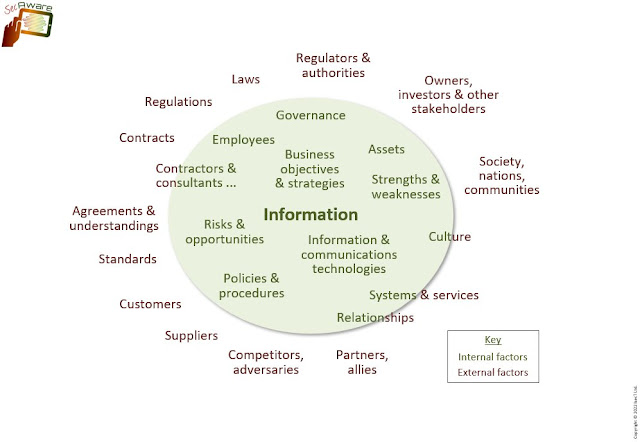
Although the organisational/business context is clearly relevant and important to information risk and security management, it is tricky to describe.  In my opinion, clause 4 of ISO/IEC 27001 is so succinct that it leaves readers perplexed as to what 'context' even means.  It stops short of explaining how to determine and make use of various 'internal and external issues' in an I nformation S ecurity M anagement S ystem.  So, to help clients, I wrote and released a pragmatic 5-page management guideline on this for the SecAware ISMS toolkit , expanding on this neat little summary diagram: With about a thousand words of explanation and pragmatic advice, the guideline has roughly ten times as many words as clauses 4.1 and 4.2 ... or twenty times if you accept that the picture is worth a thousand words. It was written independently of, and complements, ISO/IEC 27003 's advice in this area. Although I am happy with the SecAware ISMS toolkit materials as they are, I...

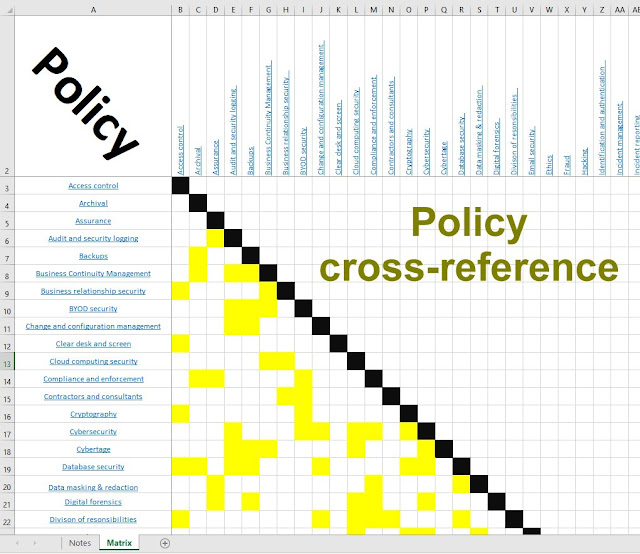
The Matrix, policy edition

Image
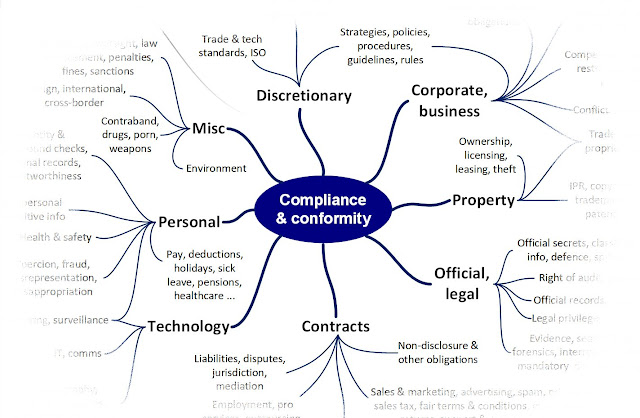
Inspired by an insightful comment on LinkeDin from an SC 27 colleague on the other side of the world (thanks Lars!), I spent most of last week updating the SecAware security policy templates and ISO27k ISMS materials . The main change was to distinguish conformity from compliance - two similar terms that I admit I had been using loosely and often incorrectly for far too long. As I now understand them: Compliance refers to fulfilling binding (mandatory) legal, regulatory and contractual obligations; Conformity concerns fulfilling optional (discretionary) requirements in standards, agreements, codes of ethics etc.   It's a fine distinction with implications for the associated information risks, given differing impacts: Noncompliance may lead to legal enforcement action (fines/penalties), other costly sanctions (such as more intrusive monitoring by the authorities and perhaps revocation of operating licenses) and business issues (such as reputational damage and brand devaluation, p...

Managing professional services engagements

Image
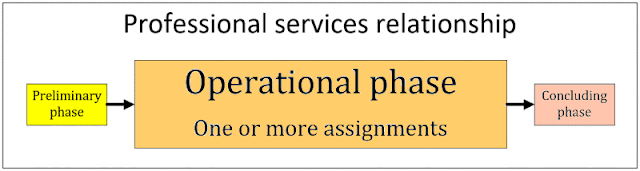
In relation to professional services, management responsibilities are shared between client and provider, except where their interests and concerns diverge. Identifying and exploiting common interests goes beyond the commercial/financial arrangements , involving different levels and types of management: Strategic management: whereas some professional services may be seen as short-term point solutions to specific issues ("temping"), many have longer-term implications such as the prospect of repeat/future business if things work out so well that the engagement is clearly productive and beneficial to both parties. Establishing semi-permanent insourcing and outsourcing arrangements can involve substantial investments and risks with strategic implications, hence senior management should be involved in considering and deciding between various options, designing and instituting the appropriate governance and management arrangements, clarifying responsibilities and accountabilities...

Professional services infosec policy template

Image
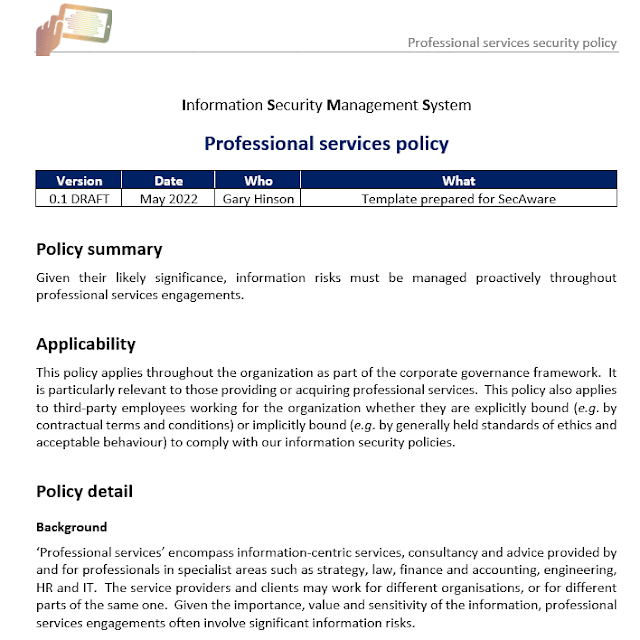
  We have just completed and released a brand new information security policy template on professional services. The policy is generic, pragmatic and yet succinct at just over 2 pages. Professional services engagements, and hence the associated information risks, are so diverse that it made no sense to specify particular infosec controls, except a few examples. Instead, the policy requires management to nominate Information Owners for each professional services engagement, and they, in turn, are required to identify, evaluate and treat the information risks. This is another shining example of the value of the 'information ownership' concept. Although they are encouraged to delegate responsibilities to, or at least take advice from, relevant, competent experts (e.g. in Information Risk and Security, Legal/Compliance, HR, IT, Procurement), Information Owners are held personally accountable for the protection and legitimate exploitation of 'their' information. If Informati...

Data masking and redaction policy

Image
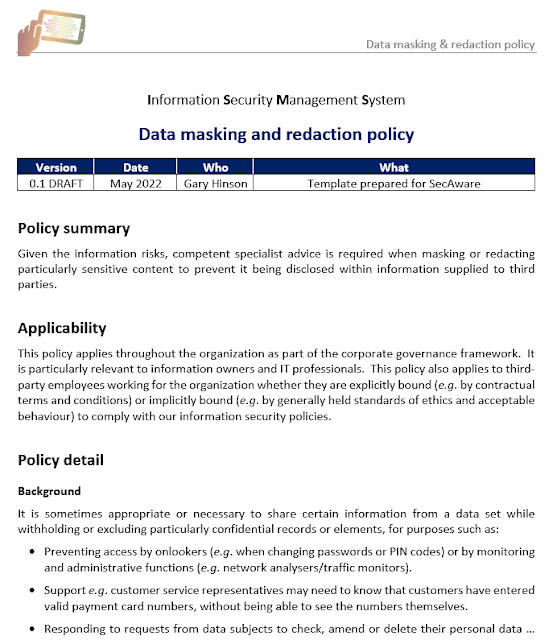
  Last evening I completed and published another SecAware infosec policy template addressing ISO/IEC 27002:2022 clause 8.11 "Data masking": "Data masking should be used in accordance with the organization’s topic-specific policy on access control and other related topic-specific, and business requirements, taking applicable legislation into consideration." The techniques for masking or redacting highly sensitive information from electronic and physical documents may appear quite straightforward. However, experience tells us the controls are error-prone and fragile: they generally fail-insecure, meaning that sensitive information is liable to be disclosed inappropriately. That. in turn, often leads to embarrassing and costly incidents with the possibility of prosecution and penalties for the organisation at fault, along with reputational damage and brand devaluation. The policy therefore takes a risk-based approach, outlining a range of masking and redaction controls...

Professional services - concluding phase

Image
Having introduced this blog series and covered information risks applicable to the preliminary and operational phases of a professional services engagement, it's time to cover the third and final phase when the engagement and business relationship comes to an end. Eventually, all relationships draw to a close. Professional services clients and providers go their separate ways, hopefully parting on good terms unless there were unresolved disagreements, issues or incidents (hinting at some information risks). It is worth considering what will/might happen at the end of a professional services engagement as early as the preliminary pre-contract phase. Some of the controls need to be predetermined and pre-agreed in order to avoid or mitigate potentially serious risks later-on. Straightforward in principle ... and yet easily neglected in the heady rush of getting the engagement going. This is not unlike a couple drawing up their "pre-nup" before a wedding, or a sensible organi...