Posts

Showing posts with the label Internet

A nightmare on DR street

Image
A provocative piece on LinkeDin by Brian Matsinger caught my beady eye and sparked my fertile imagination today. I'm presently busy amplifying the disaster recovery advice in NIS 2 for a client. When I say 'amplifying', I mean generating an entire awareness and training piece on the back of a single mention of 'disaster recovery' in all of NIS 2. Just the one. Blink and you'll miss it. Oh boy. Anyway, Brian points out that recovering from disasters caused by 'cyber attacks' requires a different DR approach than is usual for physical disasters such as storms, fires and floods. Traditional basic DR plans are pretty straightforward: essentially, the plans tell us to grab recent backups and pristine systems, restore the backups onto said systems, do a cursory check then release services to users. Job's a good 'un, off to the pub lads.

BCM for WFH

Image
Since home and mobile workers rely on IT to access critical business systems and corporate data, and to communicate with others, organisations need a robust IT network infrastructure that extends to workers' homes or wherever they hang out. If, in reality, the infrastructure turns out to be fragile and unreliable, business activities are likely to be equally fragile and unreliable, leading to frustration and grief all round. In other words, the extended IT infrastructure is quite likely business-critical. W orking F rom H ome or on the road can increase various information risks relative to conventional office-based work, due to factors such as: Use of cloud computing services*; Workers using their own or shared devices and internet connections for work purposes, raising questions about their suitability and security, ownership of and access to any intellectual property or personal information on them;

Using ChatGPT more securely

Image
Clearly there are some substantial risks associated with using AI/ML systems and services, with some serious incidents having already hit the news headlines within a few months of the release of ChatGPT. However, having been thinking carefully and researching this topic for couple of weeks, I realised there are many more risks than the reported incidents might suggest, so  I've written up what I found. This pragmatic guideline explores the information risks associated with AI/ML,  from the perspective of an organisation whose workers are using ChatGPT (as an example) .   Having identified ~26 threats, ~6 vulnerabilities and dozens of possible impactful incident scenarios, I came up with ~20  information security controls capable of mitigating many of the risks. See what you make of it. Feedback welcome. What have I missed? What controls would you suggest? 

To what extent do you trust the robots?

Image
This Sunday morning, fueled by two strong coffees, I'm cogitating on the issue of workers thoughtlessly disclosing all manner of sensitive personal or proprietary information in their queries to AI/ML/LLM systems and services run by third parties, such as ChatGPT. This is clearly topical given : (1) the deluge of publicity and chatter around ChatGPT right now, coupled with  (2) our natural human curiosity to explore new tech toys, plus  (3) limited appreciation of the associated information risks, and  (4) the rarity of controls such as policies and Data Leakage Protection technologies.  Furthermore, even if we do persuade our colleagues (and, let's be honest, ourselves!) to be more careful and circumspect about whatever we are typing or pasting into various online systems, the possibility remains that the general nature of our interests and queries is often sensitive.

Webserver problem problem

Image
This cold Winter's Monday morning, we woke to problems accessing our server and websites. The usual turnitoffandonagain approach let us down ... and this time so has downforeveryoneorjustme dotcom: It's ironic that a web service purely designed to tell us if a website is working is, itself, at least partially unresponsive - a broken control. It doesn't even say what or where the problem might be, remaining stubbornly stuck at "Checking server. Please wait ..." Ping and tracert indicate the server is still sitting pretty on its Internet perch, so my guess is something bizarre going on with the webserver, possibly an attack in progress but more likely a simple config problem somewhere along the long, long chain of links and systems between us and the server, maybe even the DNS. This is embarrssing given my professional interests, a bad start to the week but our incident management team is on the case, tooling-up as I speak. So what can I say? Normal service will b...

ISO/IEC 27400 IoT security and privacy standard published

Image
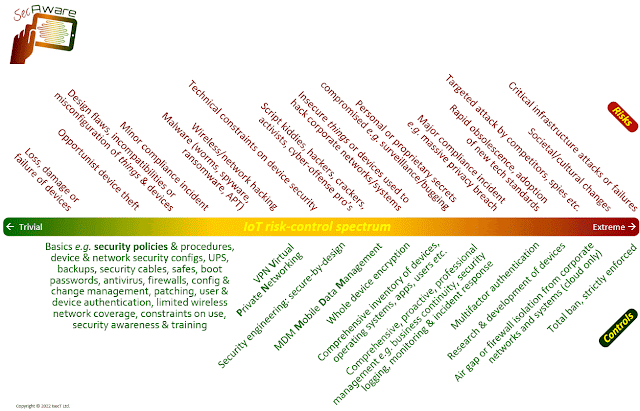
To celebrate the publication of ISO/IEC 27400:2022 today, we have slashed the price for our IoT security policy templates to just $10 each through SecAware.com. IoT policy is the first of the basic security controls shown on the 'risk-control spectrum' diagram above, and is Control-01 in the new standard ... Do you have a security policy on IoT? If not, does that mean IoT is out of control in your organisation? Even if you do, what does it say? Is it valid, appropriate, worthwhile, sufficient?   The spectrum diagram shows quite a variety of risks and controls, but it is merely a summary, selected highlights. Attempting to cover them all in a policy document would be counterproductive - in fact, general employees can barely cope with a much-simplified one-page 'acceptable use policy'.   The new ISO/IEC 27400 standard takes a broad perspective with copious advice on information security and privacy for the designers, manufacturers, purchasers, users and administrators o...

Responsible disclosure - another new policy

Image
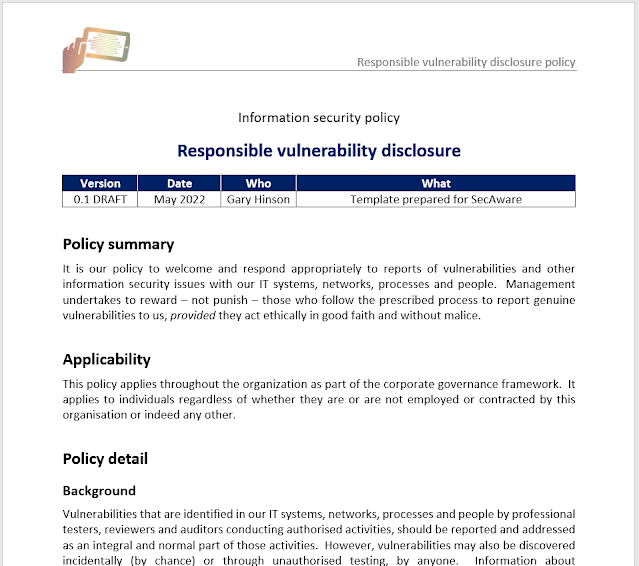
We have just completed and released another topic-specific information security policy template, covering responsible disclosure (of vulnerabilities, mostly). The policy encourages people to report any vulnerabilities or other information security issues they discover with the organisation's IT systems, networks, processes and people. Management undertakes to investigate and address reports using a risk-based approach, reducing the time and effort required for spurious or trivial issues, while ensuring that more significant matters are prioritised. The policy distinguishes authorised from unauthorised security testing, and touches on ethical aspects such as hacking and premature disclosure. It allows for reports to be made or escalated to Internal Audit, acting as a trustworthy, independent function, competent to undertake investigations dispassionately. This is a relief-valve for potentially sensitive or troublesome reports where the reporter is dubious of receiving fair, prompt t...

How many metrics?

Image
While perusing yet another promotional, commercially-sponsored survey today, something caught my beady eye. According to the report, "On average, organizations track four to five metrics".   Four to five [cybersecurity] metrics?!!  Really?   Oh boy. Given the importance, complexities and breadth of cybersecurity, how on Earth can anyone sensibly manage it with just four to five metrics? It beggars belief, particularly as the report indicates that three quarters of the 1,200 surveyed companies had at least a $billion in revenue, and more than half of them have at least 10,000 employees. With a total cybersecurity expenditure of $125billion (around 80% of the total global estimate), these were large corporations, not tiddlers. The report indicates the corresponding survey question was "Q30. Which of the following cybersecurity metrics does your organization track, and which metrics are the most important?". Well OK, that's two questions in one, and the report does...

Domotics - a can-o-worms

Image
This morning, I’ve been browsing and thinking about ISO/IEC 27403 , a draft ISO27k standard on the infosec and privacy aspects of “domotics” i.e. IoT things at home.   Compared to a [reasonably well controlled] corporate situation, there are numerous ‘challenges’ (risks) in the home setting e.g.: Limited information security awareness and competence by most people. IoT things are generally just black-boxes. Ad hoc assemblages of networked IT systems - including things worn/carried about the person (residents and visitors) and work things, not just things physically installed about the home (e.g. smart heating controls, door locks and cat feeders). Things are not [always] designed for adequate security or privacy since other requirements (such as low price and ease of use) generally take precedence. Finite processing and storage capacities, plus limited user interfaces, hamper/constrain their security capabilities. Lack of processes for mana...