Posts

Showing posts with the label Secrecy

Book review: Permanent Record by Ed Snowden

Image
Title: Permanent Record Author: Edward Snowden ISBN: 978-1-250-23723-1 Price: US$18 from Amazon GH rating: 90% Summary Until I read this book, I considered my personal integrity a fundamental strength, core to my very being. It pales in comparison to Ed's extreme courage and intense determination to expose the shocking truth about the NSA's mass surveillance programme and the way it was concealed from Congress.

Checklust security

Image
" Seventy Questions to Assess Cybersecurity Risk on a Rapidly Changing Threat Landscape "  is an ISACA 'industry news' article by Patrick Barnett.  Whereas normally I give 'industry news' and checklists a wide berth, Patrick is (according to the article) highly qualified and experienced in the field, so I took  a closer look at this one. The prospect of condensing such a broad topic to a series of questions intrigued me. I'm not totally immune to the gleaming allure of well-conceived checklists. Patrick says: "There are 70 questions that can be asked to determine whether an enterprise has most defensive principles covered and has taken steps to reduce risk (and entropy) associated with cybersecurity. If you can answer “Yes” to the following 70 questions, then you have significantly reduced your cybersecurity risk. Even so, risk still exists, and entropy must be continuously monitored and mitigated. There is no specific number of layers that can remove...

Hacking the Microsoft Sculpt keyboard

Image
In its infinite wisdom, Microsoft designed data encryption into the Sculpt wireless keyboard set to protect against wireless eavesdropping and other attacks. The keyboard allegedly* uses AES for symmetric encryption with a secret key burnt into the chips in the keyboard's very low power radio transmitter and the matching USB dongle receiver during manufacture: they are permanently paired together. The matching Sculpt mouse and Sculpt numeric keypad use the same dongle and both are presumably keyed and paired in the same way as the keyboard. This design is more secure but less convenient than, say, Bluetooth pairing. The risk of hackers intercepting and successfully decoding my keypresses wirelessly is effectively zero. Nice! Unfortunately, the keyboard, keypad and mouse are all utterly dependent on the corresponding USB dongle, creating an availability issue. Being RF-based, RF jamming would be another availability threat. Furthermore, I'm still vulnerable to upstream and downs...

Data masking and redaction policy

Image
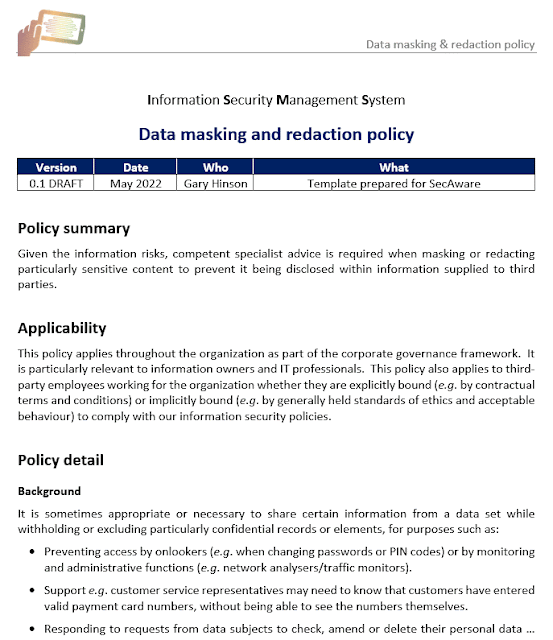
  Last evening I completed and published another SecAware infosec policy template addressing ISO/IEC 27002:2022 clause 8.11 "Data masking": "Data masking should be used in accordance with the organization’s topic-specific policy on access control and other related topic-specific, and business requirements, taking applicable legislation into consideration." The techniques for masking or redacting highly sensitive information from electronic and physical documents may appear quite straightforward. However, experience tells us the controls are error-prone and fragile: they generally fail-insecure, meaning that sensitive information is liable to be disclosed inappropriately. That. in turn, often leads to embarrassing and costly incidents with the possibility of prosecution and penalties for the organisation at fault, along with reputational damage and brand devaluation. The policy therefore takes a risk-based approach, outlining a range of masking and redaction controls...

Transparency and oversight

Image
Along with increasing legal and regulatory compliance pressures on organizations to implement appropriate privacy controls, popular awareness of the issues appears to be on the up with commercial implications for organizations. Global IT megacorps such as Facebook, Microsoft, Apple and Google are particularly exposed to public criticism simply because they are household names ... but that's not to say they are powerless, far from it.  Contrast Apple's handling of the FBI iPhone security incident against Facebook's handling of the Cambridge Analytica scandal , plus other privacy incidents. All the megacorps have to take their own cybersecurity seriously simply because they are such massive targets facing business-critical information risks: it's literally an existential issue. They are also forced to comply with various laws and regulations, for the same reasons as any other organization - to avoid potentially huge punitive fines and other substantial costs arising from...

Right to repair vs IPR

Image
This week I've been contemplating the right to repair movement, promoting the idea that c onsumers and third parties (such as repair shops) should not be legally denied the right to meddle with the stuff they have bought - to diagnose, repair and update it - without being forced to go back to the original manufacturer (a monopolistic constraint) or throw it away and buy a replacement (eco-unfriendly). Along similar lines, I am leaning towards the idea that products generally ought to be repairable and modifiable rather than disposable. That is, they should be designed with ‘repairability’ as a requirement, as well as safety, functionality, standards compliance, value, reliability and what have you. I appreciate that miniaturization, surface mounting, multi-layer PCBs, flow soldering and robotic parts placement make modern day electronic gizmos small and cheap as well as tough to repair, but obsolescence shouldn’t be built-in, deliberately, by default. Gizmos can still have test po...


Leaving a digital legacy

Image
Yesterday morning, I checked the ISO27k Forum messages as usual. Among the ping-pong of ongoing conversations was a sad request to stop emailing a Forum member who died just last week. His widow sent a few polite messages through his email account to the whole list, replying to an assortment of recent Forum emails. Presumably she didn't read or comprehend the 'unsubscribe' instructions from Google at the bottom of every message, and given the circumstances, it's entirely understandable - not least because I think she is Spanish, while the Forum and its instructions are in English. Unsubscribing someone from an email list is a simple example – something that’s easy for those of us who frequently use managed mailing lists (or groups or reflectors or Special Interest Groups or whatever they are called) but is not necessarily obvious to those who don’t, especially when they are in turmoil, grieving and overloaded with a million difficult tasks all at once. It’s an extraord...

Cyberterms

Image
With ISO/IEC JTC 1 / SC 27 still hopelessly bogged down trying to figure out what cybersecurity means, today I bumped into perhaps the most lucid cyber-definitions I've found to date in CNSS (Committee on National Security Systems) Instruction number 4009 , a glossary of US government terms last updated in 2015.   Here are most of the cyber-related terms from CNSSI 4009:  active cyber defense  Synchronized, real-time capability to discover, detect, analyze, and mitigate threats and vulnerabilities. Source: DSOC 2011 cyber incident  Actions taken through the use of an information system or network that result in an actual or potentially adverse effect on an information system, network, and/or the information residing therein. See incident. See also event, security-relevant event, and intrusion.  cybersecurity Prevention of damage to, protection of, and restoration of computers, electronic communications systems, electronic communications services, wire commu...

Plummeting toward the deadline

Image
With less than a fortnight now remaining, are you all set for the GDPR deadline with everything on your privacy projects either completed or well in hand? If not, now is your last chance to refocus on priorities and squeeze the last ounce of effort from all involved. The usual approach for many managers and team leaders facing just such a situation is to crack the whip. Maybe you have already done that. Maybe you are being thrashed, and feel obliged to do the same. Hey, listen. Stop a moment and think. That's not the only way. Assuming things have been run reasonably effectively to this point, everyone is well aware of the impending deadline. The increasing tension will be plain to all. People will have been slaving away, playing their part and (in most cases) doing their level best to hit the goal ... so piling on the pressure now may be counterproductive. When people are close to their breaking points, there's a chance they'll snap rather than bend, especially if they...

Protecting information awareness module

Image
‘Protecting information’ is a non-specific title. Almost everything that we do is about protecting information so what does February's awareness module actually cover? 'Protecting information' begs questions such as: What is the information that deserves or needs to be protected? What are the risks the information is protected against - the threats, vulnerabilities and impacts? How can or should the information be protected? Who is responsible for protecting it? For the answers, we drew inspiration from the fields of information risk management, intellectual property and knowledge management, as well as information security and governance.  As usual, we chose to discuss all kinds or forms of information in the typical business context - not just computer data. 'Knowledge' for instance includes workers' experience and expertise, trade secrets and know-how in general. The corresponding information risks and controls are quite diverse. Information classification is...

Why infosec?

Today I'm revising the  Information Security 101  presentation for general employees, starting with a brief introductory slide addressing questions along the lines of "What's the point of information security?" and "Why are you even telling me about it?". It's not as easy as you might think to answer such fundamental questions, simply, for someone who may have no background or interest in the topic. So I went Googling for inspiration, and came across this neat list of infosec benefits from a company called Global Strategic: Demonstrates a clear commitment to data security- including confidentiality and strict accessibility rules; Provides procedures to manage risk; Keeps confidential information secure; Provides a significant competitive advantage; Ensures a secure exchange of information; Creates consistency in the delivery our services; Allows for inter-operability between organizations or groups within an organization; Builds a culture of security; P...

WIP

Image
Well here we are on the tenth of the month already with April's awareness module looking disappointingly sparse at this point: Nothing is actually finished as yet (no black ticks) but there are several items on the go and the thinking is in full swing. The 'train the trainer' piece is the furthest advanced, thanks to two parts. The scope and purpose of the awareness module is taking shape (looks like the name of the module might be "Security innovation"), and we've come up with some creative and innovative ideas for security awareness - quite a few in fact. After furiously writing a page of bullet points I had to take a break in order to get on with other things. Those 'other things' included discussing some potential ISO27k consulting work with a new client and trying to find out what happened to a previous metrics consulting/training proposal that plummeted into the deep dark depths of the NZ government official tendering process. [Conveniently, the ...

Sir Veillance

Image
Aside from the obvious effects on the agency and the US government, today's Wikileaks disclosure concerning the CIA's capabilities to hack various technologies is a global concern for our “industry”, or rather our profession, our craft, taking in the information risk, security and related fields (such as business continuity, privacy and compliance) as a whole.  At a high level, major incidents reflect badly on all of us and are embarrassing … and yet scratching beneath the surface things invariably get more complex and convoluted in practice. There are reasons why things happened and were not avoided, identified, blocked or mitigated. We are where we are in the industry as a result of all that has gone before, including long-term cumulative effects of a gazillion decisions and events and developments along the way, not all of which were ours ( e.g. cloud computing, BYOD and IoT/IIoT are three classic examples of areas where information security pros are openly concerned abo...

Raising awareness of surveillance risks

Image
We have just uploaded the latest awareness module on surveillance for our subscribers.  As you’ll appreciate from the word cloud, this is fascinating topic, something we hope will really catch workers' imaginations and so get them thinking and chatting (an awareness win!). Our two main areas of focus in the new module are:  (1) Surveillance of various kinds conducted by the organization ( e.g. CCTV coverage of public and controlled areas, network traffic monitoring, system security and audit logs, spam and malware scanning); and  (2) Surveillance conducted on the organization and its workers by various third parties ( e.g. compliance monitoring by various authorities, and industrial espionage or spying by competitors). With some exceptions, the former is authorized by management for legitimate business purposes, while the latter can be sinister ( e.g. Big Brother and industrial espionage). The tools and techniques to mitigate the risks include counter-surveillance...

Surveillance: awareness challenge or opportunity?

Image
We're busy preparing February's security awareness module on the topic of surveillance . As often happens, what we anticipated would be a fairly narrow and specific issue has mushroomed before our very eyes as we've delved into the writing. We're now looking at surveillance on the population by the authorities, by the organization on workers and third parties, by third party organizations on workers, and by individuals on each other ... The awareness module covers a fascinatingly diverse patchwork of information risks e.g. industrial espionage and intelligence, health and safety, network and physical security monitoring, oversight and supervision, privacy and confidentiality, office security, things , portable devices, artificial intelligence, hacking, malware and more. We've covered all of them separately but this is our chance to bring them together - an awareness story with with a novel perspective. The news story about a TV presenter's verbal comment alleg...