Posts

Showing posts with the label Physical

An evolutionary revolution?

Image
"Mitigation and adaptation are required together to reduce the risks and impacts of climate change, including extreme weather events. Mitigation refers to actions taken to limit the amount of greenhouse gas emissions, reducing the amount of future climate change. Adaptation refers to actions taken to limit the impacts of a changing climate. Mitigation and adaptation together provide co-benefits for other environmental and social goals." That paragraph by Lizzie Fuller, Climate Science Communicator for the UK's Met Office, plucked from another excellent digest of lessons learned from various UK resilience exercises and initiatives , obviously con cerns climate change ... but it occurs to me that 'mitigate and adapt' might be a novel approach to information risks and impacts as well.

A nightmare on DR street

Image
A provocative piece on LinkeDin by Brian Matsinger caught my beady eye and sparked my fertile imagination today. I'm presently busy amplifying the disaster recovery advice in NIS 2 for a client. When I say 'amplifying', I mean generating an entire awareness and training piece on the back of a single mention of 'disaster recovery' in all of NIS 2. Just the one. Blink and you'll miss it. Oh boy. Anyway, Brian points out that recovering from disasters caused by 'cyber attacks' requires a different DR approach than is usual for physical disasters such as storms, fires and floods. Traditional basic DR plans are pretty straightforward: essentially, the plans tell us to grab recent backups and pristine systems, restore the backups onto said systems, do a cursory check then release services to users. Job's a good 'un, off to the pub lads.

Mil-spec management lessons

Image
  "A calamity can often strike without warning. Whether it be generated by humans or a natural disaster, leaders need to be ready to direct their teams in the aftermath. In order to be ready for crisis, leadership skills, like any others, must be practised over and over beforehand. So the way you lead in the quiet times helps to build the skills you need when you have to dig deep." That paragraph plucked from this month's impressive  NZ Airforce newsletter  about the military response to the devastating flooding caused by cyclone Gabrielle here in Hawkes Bay caught my beady eye this morning.  The idea of practicing incident management as well as incident handling or operations  on relatively small incidents makes perfect sense.

27001 & climate change (FREE!)

Image
Like other ISO management systems standards, ISO/IEC 27001:2022 has just been amended to incorporate two small wording changes : “The organization shall determine whether climate change is a relevant issue” (clause 4.1); “NOTE: Relevant interested parties can have requirements related to climate change.” (clause 4.2). So, it is fair to ask what has climate change got to do with information risk and security? Is it even relevant? Having been been mulling that over for quite some while now, I've come up with a dozen points of relevance: For more on those twelve, read " Secure the Planet " - a FREE white paper. The clock in that image is a reminder that time is pressing, so here are half-a-dozen things information risk and security professionals can do to help.

Checklust security

Image
" Seventy Questions to Assess Cybersecurity Risk on a Rapidly Changing Threat Landscape "  is an ISACA 'industry news' article by Patrick Barnett.  Whereas normally I give 'industry news' and checklists a wide berth, Patrick is (according to the article) highly qualified and experienced in the field, so I took  a closer look at this one. The prospect of condensing such a broad topic to a series of questions intrigued me. I'm not totally immune to the gleaming allure of well-conceived checklists. Patrick says: "There are 70 questions that can be asked to determine whether an enterprise has most defensive principles covered and has taken steps to reduce risk (and entropy) associated with cybersecurity. If you can answer “Yes” to the following 70 questions, then you have significantly reduced your cybersecurity risk. Even so, risk still exists, and entropy must be continuously monitored and mitigated. There is no specific number of layers that can remove...

eWaste safety hazards and information risks

Image
A warning in the New Zealand Information Security Manual  caught my beady eye yesterday: “Electrical and electronic equipment contains a complex mix of materials, components and substances, many which can be poisonous, carcinogenic or toxic in particulate or dust form. Destruction and disposal of WEEE [Waste from Electrical and Electronic Equipment] needs to be managed carefully to avoid the potential of serious health risk or environmental hazard.” Disposing of eWaste presents environmental and safety hazards arising from noxious/toxic/carcinogenic chemicals such as gallium arsenide (GaAs) and polychlorinated biphenyls (PCBs), plus the obvious dangers when handling sharp-edged metal or plastic chassis fragments, wires, printed circuit boards and CD/DVD discs plus  leaky electrolytic capacitors and old batteries . While there may be money to be made by extracting and recycling valuable metals  and reusable components ,  subsystems and modules , that's really a jo...

Memories of an O.F.

Image
I freely admit to being an Old Fart, old and plenty farty enough to remember a time even before the DTI Code of Practice was released and then in 1995 became  BS7799 , making information security A Thing. OK so I'm not quite so old as to remember when computers were women in rank and file, studiously calculating missile trajectories, but I've read about them and I remain fascinated by the early mechanical, electro-mechanical and then electronic computers - initially single-purpose tools such as that nice Mr Babbage's difference engine, then machines capable of various tasks using toggle switches, punched tape and cards to program their instructions. Back in the 80's when I escaped the genetics lab to become a net/sysadmin, computer security was just becoming important: people (particularly managers, few of whom had a clue about IT) were vaguely concerned about these new fangled, complicated, mysterious and expensive computers. Securing data processing hardware was seen ...

The power of power measurement

Image
Electrical power consumption by a computer cupboard, IT room, tech suite, data centre or facility  is one of my favourite [pet!] metrics   for several reasons: It is readily measured using a wattmeter, watt-hour meter or ammeter on the main supply line/s; Compared to more technical metrics, power is simple to plot, report, explain and understand; As the installed IT equipment and usage gradually changes, so does the power consumption. It is straightforward to track and predict the overall trends without necessarily measuring and controlling every single item and change;  Step changes in power consumption indicate substantial changes in the IT equipment or usage. Marked decreases are welcome but quite rare ( e.g . as older equipment is retired from service or replaced by more modern, energy-efficient stuff), whereas marked increases in consumption - especially if unexpected - may be cause for concern; The first law of thermodynamics tells us that all the input energy has t...

Two dozen data centre fire controls

Image
Fire is clearly a significant risk to any data centre given that  a major incident (disaster!) is reported globally roughly every quarter year on average  plus an unknown number of smaller/unreported ones. Limited public disclosure of data centre fire investigation reports makes it tough, even for experienced professionals , to assess and quantify the risk.  However, s ince the likely impacts and costs of such major incidents are obviously non-trivial and the number of incidents is definitely not zero, it would be negligent to ignore the risks. Controls to avoid, mitigate or share data centre/IT facility fire risks include: Governance and management arrangements taking due account of information risks including physical security aspects when designing and procuring information services such as commercial cloud services and data centre/co-location facilities - which, by the way, don't automatically reduce

COVID information risk analysis - retrospective

Image
Two and a half years ago in March 2020 as we were fast approaching our first lockdown, I published the following P robability I mpact G raph depicting my analysis of the information risks relating to COVID: The PIG reports the information risks I identified at the time, thinking about COVID from the general societal perspective as opposed to a personal or organisational perspective.

Skyscraper of cards

Image
Having put it off for far too long, I'm belatedly trying to catch up with some standards work in the area of R oot o f T rust, which for me meant starting with the basics, studying simple introductory articles about RoT. As far as I can tell so far, RoT is a concept -  the logical basis, the foundation on which secure IT systems are built. 'Secure IT systems' covers a huge range. At the high end are those used for national security and defence purposes, plus safety- and business-critical systems facing enormous risks (substantial threats and impacts). At the low end are systems where the threats are mostly accidental and the impacts negligible - perhaps mildly annoying. Not being able to tell precisely how many steps you've taken today, or being unable to read this blog, is hardly going to stop the Earth spinning on its axis. In fact' mildly' may be overstating it. 'Systems' may be servers, desktops, portables and wearables, plus IoT things and all mann...

Hacking the Microsoft Sculpt keyboard

Image
In its infinite wisdom, Microsoft designed data encryption into the Sculpt wireless keyboard set to protect against wireless eavesdropping and other attacks. The keyboard allegedly* uses AES for symmetric encryption with a secret key burnt into the chips in the keyboard's very low power radio transmitter and the matching USB dongle receiver during manufacture: they are permanently paired together. The matching Sculpt mouse and Sculpt numeric keypad use the same dongle and both are presumably keyed and paired in the same way as the keyboard. This design is more secure but less convenient than, say, Bluetooth pairing. The risk of hackers intercepting and successfully decoding my keypresses wirelessly is effectively zero. Nice! Unfortunately, the keyboard, keypad and mouse are all utterly dependent on the corresponding USB dongle, creating an availability issue. Being RF-based, RF jamming would be another availability threat. Furthermore, I'm still vulnerable to upstream and downs...

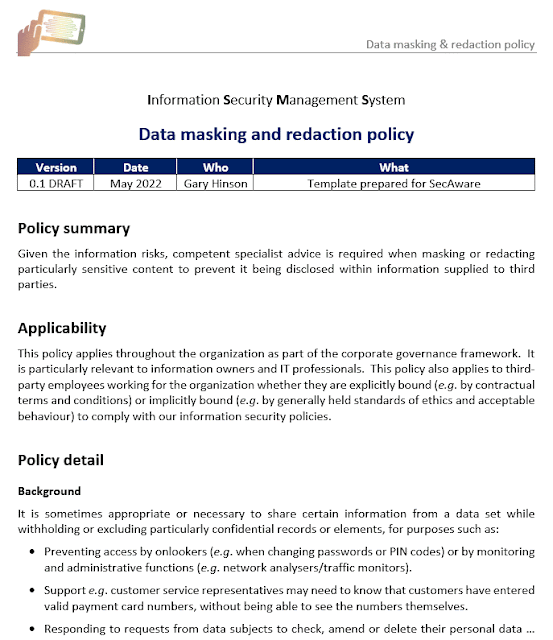
Data masking and redaction policy

Image
  Last evening I completed and published another SecAware infosec policy template addressing ISO/IEC 27002:2022 clause 8.11 "Data masking": "Data masking should be used in accordance with the organization’s topic-specific policy on access control and other related topic-specific, and business requirements, taking applicable legislation into consideration." The techniques for masking or redacting highly sensitive information from electronic and physical documents may appear quite straightforward. However, experience tells us the controls are error-prone and fragile: they generally fail-insecure, meaning that sensitive information is liable to be disclosed inappropriately. That. in turn, often leads to embarrassing and costly incidents with the possibility of prosecution and penalties for the organisation at fault, along with reputational damage and brand devaluation. The policy therefore takes a risk-based approach, outlining a range of masking and redaction controls...

Domotics - a can-o-worms

Image
This morning, I’ve been browsing and thinking about ISO/IEC 27403 , a draft ISO27k standard on the infosec and privacy aspects of “domotics” i.e. IoT things at home.   Compared to a [reasonably well controlled] corporate situation, there are numerous ‘challenges’ (risks) in the home setting e.g.: Limited information security awareness and competence by most people. IoT things are generally just black-boxes. Ad hoc assemblages of networked IT systems - including things worn/carried about the person (residents and visitors) and work things, not just things physically installed about the home (e.g. smart heating controls, door locks and cat feeders). Things are not [always] designed for adequate security or privacy since other requirements (such as low price and ease of use) generally take precedence. Finite processing and storage capacities, plus limited user interfaces, hamper/constrain their security capabilities. Lack of processes for mana...

Policy development process: phase 2

Image
Today we completed and published a new "topic-specific" information security policy template on clear desk and screen . Having previously considered information risks within the policy scope, writing the policy involved determining how to treat the risks and hence what information security or other controls are most appropriate.   Here we drew on guidance from the ISO27k standards, plus other standards, advisories and good practices that we've picked up in the course of ~30 years in the field, working with a variety of industries and organizations - and that's an interesting part of the challenge of developing generic policy templates. Different organizations - even different business units, departments, offices or teams within a given organization - can take markedly different attitudes towards clear desk and screen. The most paranoid are obsessive about it, mandating controls that would be excessive and inappropriate for most others. Conversely, some are decidedly l...

March 28 - NZ lockdown day 3 of N

Image
With a bit of lateral thinking, there are ways to hook-in to and even exploit the COVID-19 brouhaha. More time for reflection is one of the advantages of the lockdown, for some of us at least.  Many organizations, for instance, have sent out customer comms about what they are doing to maintain services during/despite the pandemic. Although most are matter-of-fact and boring (maybe not even branded), some are more creative and engaging, even acknowledging that COVID is not going to blow over in a couple of weeks. Most are generic, superficial and bland, often supplier-focused, whereas some are personalised, unique, detailed and customer-focused. Most appear to be one-off broadcasts, hurriedly cobbled together by teams immersed in the chaos and confusion, then slowly refined and authorized. Not many that I've seen so far even hint that there might be more to come. The odd tinge of humour is welcome.   Unlike the vast majority of incidents and crises, a global incident such ...