Posts

Showing posts with the label Trade secrets

Pro services under attack

Image
Among all the other bad news in the excellent Cy-Xplorer 2023 report from Orange Cyberdefense , this nugget of threat intelligence poked me in the eye: I've become increasingly concerned about the information risks relating to professional services in recent years. They seem obvious targets for malicious cyber attacks, given:

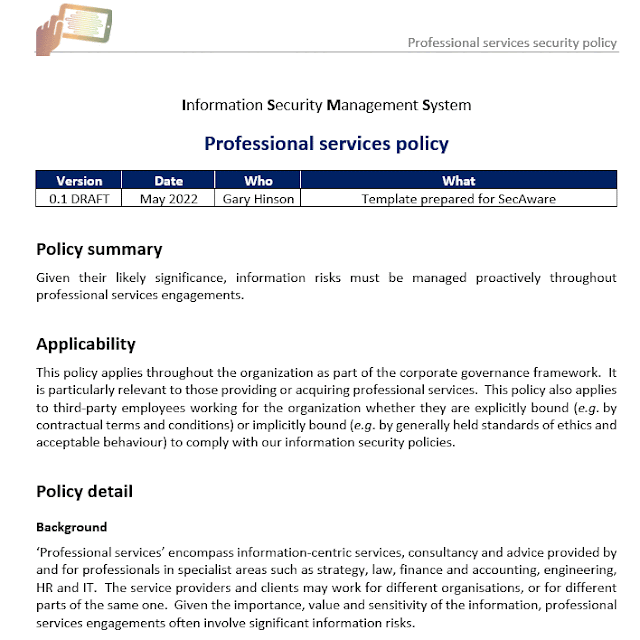
Professional services infosec policy template

Image
  We have just completed and released a brand new information security policy template on professional services. The policy is generic, pragmatic and yet succinct at just over 2 pages. Professional services engagements, and hence the associated information risks, are so diverse that it made no sense to specify particular infosec controls, except a few examples. Instead, the policy requires management to nominate Information Owners for each professional services engagement, and they, in turn, are required to identify, evaluate and treat the information risks. This is another shining example of the value of the 'information ownership' concept. Although they are encouraged to delegate responsibilities to, or at least take advice from, relevant, competent experts (e.g. in Information Risk and Security, Legal/Compliance, HR, IT, Procurement), Information Owners are held personally accountable for the protection and legitimate exploitation of 'their' information. If Informati...

Professional services - concluding phase

Image
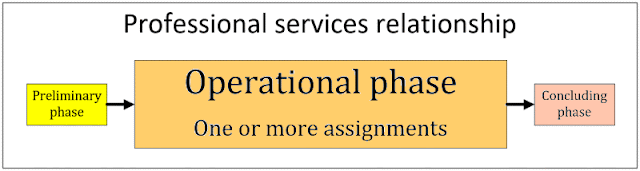
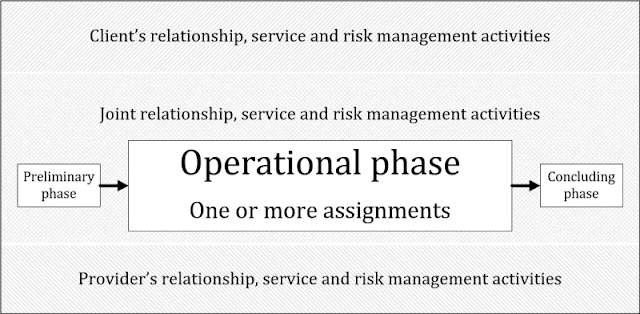
Having introduced this blog series and covered information risks applicable to the preliminary and operational phases of a professional services engagement, it's time to cover the third and final phase when the engagement and business relationship comes to an end. Eventually, all relationships draw to a close. Professional services clients and providers go their separate ways, hopefully parting on good terms unless there were unresolved disagreements, issues or incidents (hinting at some information risks). It is worth considering what will/might happen at the end of a professional services engagement as early as the preliminary pre-contract phase. Some of the controls need to be predetermined and pre-agreed in order to avoid or mitigate potentially serious risks later-on. Straightforward in principle ... and yet easily neglected in the heady rush of getting the engagement going. This is not unlike a couple drawing up their "pre-nup" before a wedding, or a sensible organi...

Information risk and security for professional services

Image
When you acquire or provide professional services, how do you address the associated information risks? I have in mind consultancy, advisory and other specialist services such as: Building and construction services e.g. architecture, surveying; B usiness services e.g. marketing and sales, strategy and management consulting, auditing, quality consulting; E ngineering services e.g. electrical and electronic design, materials science, measurement and calibration; F inancial services e.g. book-keeping and accounting, investment, tax and insurance advice, credit-checking; H uman resources services e.g. recruitment, employment disputes, mentoring and training; IT and telecommunications services e.g. Internet services, cloud computing, technical support and advice, outsourced development, datacentre facilities; L egal services e.g. commercial and family law, contracting, disputes, compliance, forensics, prosecution and defence, intellectual property protection; S ecurity services e.g....

Pinball management

Image
It could be argued that ‘management’ of all kinds (including information risk and security management) is or rather  should be a rational process, meaning that managers should systematically gather and evaluate information, take account of sound advice, make sensible decisions, put in place whatever is necessary to implement the decisions etc. , all the time acting in the organization's best interests, furthering its business objectives, strategies, policies etc. In practice, there are all manner of issues with that approach that complicate matters, frustrate things, and lead to ‘suboptimal’ situations that may be - or at least appear to be - irrational, inappropriate or unnecessary.   In particular, there are numerous paradoxes. For examples: The obvious core objective of a typical commercial company to make a substantial profit for its owners may conflict with various ethical and legal objectives to spend money on protecting and furthering the wider interests of society an...

Right to repair vs IPR

Image
This week I've been contemplating the right to repair movement, promoting the idea that c onsumers and third parties (such as repair shops) should not be legally denied the right to meddle with the stuff they have bought - to diagnose, repair and update it - without being forced to go back to the original manufacturer (a monopolistic constraint) or throw it away and buy a replacement (eco-unfriendly). Along similar lines, I am leaning towards the idea that products generally ought to be repairable and modifiable rather than disposable. That is, they should be designed with ‘repairability’ as a requirement, as well as safety, functionality, standards compliance, value, reliability and what have you. I appreciate that miniaturization, surface mounting, multi-layer PCBs, flow soldering and robotic parts placement make modern day electronic gizmos small and cheap as well as tough to repair, but obsolescence shouldn’t be built-in, deliberately, by default. Gizmos can still have test po...

Craftsmanship

Image
Currently I'm getting things ready for the next consultancy gig. Figuratively speaking, having cleared a space on the workbench, I'm stocking up on raw materials and selecting tools for my toolbox. Literally, that's simply a new directory for the assignment, a few potentially useful templates and public information from the client, and a bunch of methods and techniques in mind. My favourite tools are pre-loved and well-honed. They are familiar, comfortable and trustworthy. Some of them (such as the ISO27k standards) are off-the-shelf products. Others are either homebrewed or customized for particular purposes. They all have their advantages and disadvantages and, like any craftsman, I much prefer to use the right tool for the job, hence some specialist items are rarely used but invaluable for specific tasks. I make the effort to check and maintain my tools, from time to time investing in new ones or "improving" (well OK, refurbishing and adapting) old ones. Very ...

Off-site security

Image
Do your mobile sales reps look after the information relating to products, pricing, contracts, supplies, specifications, strategies and all that – not just the sales apps, spreadsheets and slide decks on their laptops, tablets and smartphones, but all the other sensitive and valuable corporate and personal data they carry or access? What about your roaming product/tech support and maintenance people? Your company doctor? The Board of Directors? Managers and business travelers generally? Workers catching up with email on their way home, or putting the final touches on a progress report while stretched out on the couch watching an episode of CSI? Are they vigilant and alert? Do they have the faintest clue about the information risks around them, or what's expected of them in the way of information security and privacy? Do they  care ? Portable ICT has revolutionized our lives to the point that we take it for granted these days. We've become b lasé  about it. No longer are we tie...

Acceptable Use Policies

Image
A question came up on the ISO27k Forum about an A cceptable U se P olicy. I'll take this opportunity to dispense a few Hinson Tips (free, and worth every penny!).  AUP isn’t a generally-defined and globally-agreed term. Even “policy” has a spectrum of meanings. So, regardless of what any of us might think or claim it means, what matters is the organization that’s using it – the organizational context. What does your management expect an AUP to be? To achieve? To look like? You should get some useful clues from other similar materials in other areas such as IT, HR and Finance, other functions that to some extent formally express directives. They may or may not be called AUPs, so take a look around the policy-related guidance materials, and preferably talk to the original authors about their work. You will probably pick up some useful tips, maybe even some help to knock your materials into shape.  Some organizations use AUPs formally, stating employees' obligations for l...

The business case for security awareness

Image
A day or so ago I wrote about organizations being pressured into security awareness for compliance reasons.  With some exceptions, compliance is externally imposed and doesn't directly benefit the organization through increased profits - rather it avoids or reduces the losses and costs (including penalties) associated with non compliance.  That is still a financial benefit but with negative, oppressive connotations.  Today I'm moving on to more positive, profitable matters, the business benefits arising from security awareness and training, of which there are several: Better recognition and identification of information risks More appreciation and understanding of information risks Fewer, less costly incidents Better governance Greater organizational and personal resilience Organizational learning and sustained improvement (maturity) A genuine, deep-rooted and all-encompassing corporate security culture Deterrence Getting the most out of other information security control...

Sticky ends

Image
Surveys typically show that:  Most organizations have some form of BYOD scheme encouraging or permitting workers to use their own laptops, smartphones and tablets for work; and IoT is spreading fast but still has a long way to go before it peaks. We infosec geeks may throw up our hands in horror ... but the facts remain: BYOD and IoT are popular, now. They are here to stay  and almost certain to expand . It's too late now for us to bleat on about the information risks and security concerns*. The train has long since left the station. So how should we handle this situation? An obvious approach is to retrospectively identify, assess and treat the information risks as best we can, emphasizing threats such as hackers, malware, theft or loss of information, and inappropriate disclosure, and promoting security controls such as - well, that's where it gets tricky because we have limited options for technical controls, and (despite our best efforts!) security awareness is never going ...