Posts

Showing posts with the label Insider

Insider risks

Image
There are information risks associated with people joining any corporate function – information risks that deserve to be identified, assessed, evaluated and treated appropriately like any other. If your organisation currently pays little if any attention to these risks, how about developing and trialling a suitable strategy and approach for, say, the information risk and security management function, as a pilot or demonstrator for other corporate functions and rĂ´les that place a high reliance on the personal integrity of their people?

Passionate dispassion

Image
Someone who is actively involved in, or is managing, an activity is patently not independent of it. They may well make a conscious, rational and determined effort to be objective, dispassionately reviewing evidence etc ., but their subconscious/emotional biases/prejudices and beliefs/value-systems will inevitably influence what they do. With the best will in the world, they will struggle to challenge and assess their past decisions and activities, especially if they were "certain" or "determined" or genuinely believed they were "doing the right thing". Furthermore, it is very hard for anyone to review the things they did not do, decisions they did not make or options they did not even consider. Mostly, they remain out of sight or out of the question.

Book review: Permanent Record by Ed Snowden

Image
Title: Permanent Record Author: Edward Snowden ISBN: 978-1-250-23723-1 Price: US$18 from Amazon GH rating: 90% Summary Until I read this book, I considered my personal integrity a fundamental strength, core to my very being. It pales in comparison to Ed's extreme courage and intense determination to expose the shocking truth about the NSA's mass surveillance programme and the way it was concealed from Congress.

Systematically improving professional services

Image
My beady eye has been caught by another excellent thought-provoking Protiviti article by Jim DeLoach with Randy Armknecht concerning board-level blind spots. I highly recommend reading and contemplating Are There Blind Spots in Your Boardroom ? Jim and Randy offered ten practical suggestions for boards to address the issue. Here they are with my thoughts and ideas on how to apply them in other contexts, besides the boardroom, such as within the information risk and security management team for example: Assess whether current board culture, composition and agendas are fit for purpose in the current disruptive business environment. Assess the current team culture, composition, priorities, skills & competences, expertise, relationships, interests etc. with a view towards the future. How should the team evolve or adapt to changing circumstances, building on past successes and learning from failures?

Measuring and managing ethics

Image
KPMG's Soft Controls model caught my beady eye this week: KPMG are evidently using these 8 factors to analyse, measure and help clients manage their corporate cultures, claiming that "Our model gives organisations a valid tool for getting a clear picture of the current organisational situation, confront it, and break through the silence and passivity." Hmmm, 'silence and passivity', really KPMG? Well OK, whatever. It appears to be a viable approach.

Mil-spec management lessons

Image
  "A calamity can often strike without warning. Whether it be generated by humans or a natural disaster, leaders need to be ready to direct their teams in the aftermath. In order to be ready for crisis, leadership skills, like any others, must be practised over and over beforehand. So the way you lead in the quiet times helps to build the skills you need when you have to dig deep." That paragraph plucked from this month's impressive  NZ Airforce newsletter  about the military response to the devastating flooding caused by cyclone Gabrielle here in Hawkes Bay caught my beady eye this morning.  The idea of practicing incident management as well as incident handling or operations  on relatively small incidents makes perfect sense.

What do auditors do, and for whom? [L O N G]

Image
Once again, my day kicked off with a stimulating and fruitful debate on the ISO27k Forum as members responded to a request for help to find accredited I nformation S ecurity Management S ystem certification auditors who will add value to the organisation above and beyond the ISO/IEC 27001 conformity certificate. The original poster copped some grief from the forum in appearing to seek certification auditors who would be kind on the organisation, supporting its business objectives more strongly than its conformity with the standard ... but a follow-up message clarified the position. Aris confirmed to us that he sought:  "advice on where (in cases of an ISO audit) and how (in cases of an Internal audit) our ISMS could/should be improved, but I need that advice to be meaningful, grounded, and delivered in a way that has the best probability it will be absorbed by the business. In other words, I would like this process to offer real value to the business, besides just bein...

BCM for WFH

Image
Since home and mobile workers rely on IT to access critical business systems and corporate data, and to communicate with others, organisations need a robust IT network infrastructure that extends to workers' homes or wherever they hang out. If, in reality, the infrastructure turns out to be fragile and unreliable, business activities are likely to be equally fragile and unreliable, leading to frustration and grief all round. In other words, the extended IT infrastructure is quite likely business-critical. W orking F rom H ome or on the road can increase various information risks relative to conventional office-based work, due to factors such as: Use of cloud computing services*; Workers using their own or shared devices and internet connections for work purposes, raising questions about their suitability and security, ownership of and access to any intellectual property or personal information on them;

Novel insider threat

Image
A post on LinkeDin this morning led me to a news piece  about an IT professional's attempt to divert/steal his employer's payoffs for a ransomware infection, back in 2018. According to the article, his attempt ultimately failed, largely due to his inept and naive execution ... but I have not come across this particular insider threat before. It was a new one on me, a man-in-the-middle attack layered on top of the ransomware.

eWaste safety hazards and information risks

Image
A warning in the New Zealand Information Security Manual  caught my beady eye yesterday: “Electrical and electronic equipment contains a complex mix of materials, components and substances, many which can be poisonous, carcinogenic or toxic in particulate or dust form. Destruction and disposal of WEEE [Waste from Electrical and Electronic Equipment] needs to be managed carefully to avoid the potential of serious health risk or environmental hazard.” Disposing of eWaste presents environmental and safety hazards arising from noxious/toxic/carcinogenic chemicals such as gallium arsenide (GaAs) and polychlorinated biphenyls (PCBs), plus the obvious dangers when handling sharp-edged metal or plastic chassis fragments, wires, printed circuit boards and CD/DVD discs plus  leaky electrolytic capacitors and old batteries . While there may be money to be made by extracting and recycling valuable metals  and reusable components ,  subsystems and modules , that's really a jo...

Using ChatGPT more securely

Image
Clearly there are some substantial risks associated with using AI/ML systems and services, with some serious incidents having already hit the news headlines within a few months of the release of ChatGPT. However, having been thinking carefully and researching this topic for couple of weeks, I realised there are many more risks than the reported incidents might suggest, so  I've written up what I found. This pragmatic guideline explores the information risks associated with AI/ML,  from the perspective of an organisation whose workers are using ChatGPT (as an example) .   Having identified ~26 threats, ~6 vulnerabilities and dozens of possible impactful incident scenarios, I came up with ~20  information security controls capable of mitigating many of the risks. See what you make of it. Feedback welcome. What have I missed? What controls would you suggest? 

mmmmmm, More Meaningful Management Metrics

Image
For about a week, I've enjoyed following and participating in an expansive discussion thread on LinkeDin about the value of measurement and metrics for management , debating various issues that can occur both in theory and in practice. One straw-man argument is that 'managing by the numbers' can imply a myopic focus on commonplace business metrics such as stock price or annual profit, both of which can be manipulated to some extent by managers even at the expense of long term resilience and commercial success, let alone other business objectives. Despite Taylor's outmoded 'scientific management' experiments having been debunked a century ago, some LinkeDinners in the thread evidently still believe that science (in the form of numeric data) and management are poles apart.  I beg to differ. That's so last century! Management is complex, dynamic and nuanced, hence I accept that simplistic or crude metrics can't possibly address the entire practice. For exam...

To what extent do you trust the robots?

Image
This Sunday morning, fueled by two strong coffees, I'm cogitating on the issue of workers thoughtlessly disclosing all manner of sensitive personal or proprietary information in their queries to AI/ML/LLM systems and services run by third parties, such as ChatGPT. This is clearly topical given : (1) the deluge of publicity and chatter around ChatGPT right now, coupled with  (2) our natural human curiosity to explore new tech toys, plus  (3) limited appreciation of the associated information risks, and  (4) the rarity of controls such as policies and Data Leakage Protection technologies.  Furthermore, even if we do persuade our colleagues (and, let's be honest, ourselves!) to be more careful and circumspect about whatever we are typing or pasting into various online systems, the possibility remains that the general nature of our interests and queries is often sensitive.

Riding the waves

Image
  Yesterday, I wrote about preparing and promoting your budget proposal, strategy, programme of projects or an individual initiative, gaining management support and negotiating for approval. Today I'd like to emphasis a fleeting, easily overlooked step in your journey, an opportunity to do even better. At the very moment when the negotiations are completed and management finally agrees your infosec budget, their interest, motivation and support for it is high ... so, before the dust settles, why not seize the moment: a window of opportunity has opened. Before long, the wave of enthusiasm will subside and management's focus will turn to other matters. 

7 security culture strengtheners

Image
Given research indicating that security culture trumps security policies , how can we strengthen the corporate security culture? Here are a few ideas to set you thinking:

Oversight is ...

Image
... "various forms of supervision and inspection used to ensure that important information security activities and controls are operating properly, and to identify any anomalies" [source:  SecAware glossary ] ... "forgetfulness, carelessness, neglect or incompetence, typically leading to errors, omissions and other information security incidents" [source:  SecAware glossary ] ... absent from ISO/IEC 27002 except for one measly mention (clause 5.16) ... maintaining a watching brief ... an opportunity to review ... the four eyes principle ... the act of overseeing ... the prompt to revisit ... keeping a close eye ... hands off, eyes on ... something missed ... a sign of dis trust ... an opportunity ... a vulnerability ... a sign of  trust ... incompetence ... management ... carelessness ... an omission ... an accident ... an override ... supervision ... inspection ... ineptitude ... a problem ... assurance ... a mistake ... authority ... guidance ... a control ... che...

Security awareness month

Image
Since October is cybersecurity awareness month in the USA, we've seized the opportunity to update SecAware.com with additional information on our security awareness material.  SecAware's information security awareness modules explore a deliberately wide variety of individual topics in some depth:

Ten tips on tackling a thorny infosec issue

Image
A member approached the  ISO27k Forum   this morning for advice: " What would you recommend to do if our warnings as ISMS department specialists/auditors are not taken into account?" What can realistically be done if  management isn't paying sufficient attention to information risks that we believe are significant ?  This is a thorny issue and not an uncommon challenge, particularly among relatively inexperienced or naĂ¯ve but eager information risk and security professionals, fresh out of college and still studying hard for their credentials. It can also afflict the greybeards among us: our passion for knocking down information risks can overtake our abilities to convince managers and clients. Here are ten possible responses to consider: 

The business context for information risk and security

Image
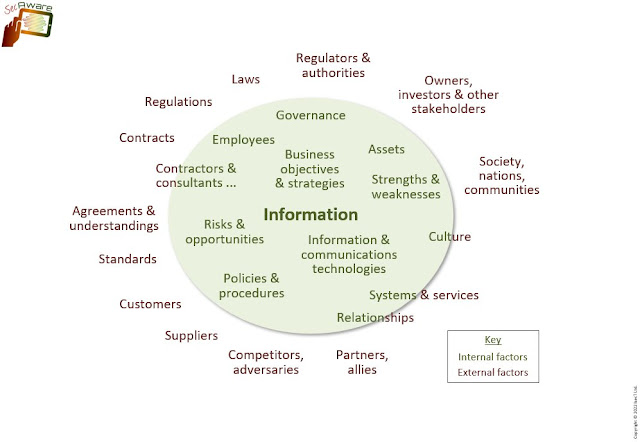
Although the organisational/business context is clearly relevant and important to information risk and security management, it is tricky to describe.  In my opinion, clause 4 of ISO/IEC 27001 is so succinct that it leaves readers perplexed as to what 'context' even means.  It stops short of explaining how to determine and make use of various 'internal and external issues' in an I nformation S ecurity M anagement S ystem.  So, to help clients, I wrote and released a pragmatic 5-page management guideline on this for the SecAware ISMS toolkit , expanding on this neat little summary diagram: With about a thousand words of explanation and pragmatic advice, the guideline has roughly ten times as many words as clauses 4.1 and 4.2 ... or twenty times if you accept that the picture is worth a thousand words. It was written independently of, and complements, ISO/IEC 27003 's advice in this area. Although I am happy with the SecAware ISMS toolkit materials as they are, I...

Responsible disclosure - another new policy

Image
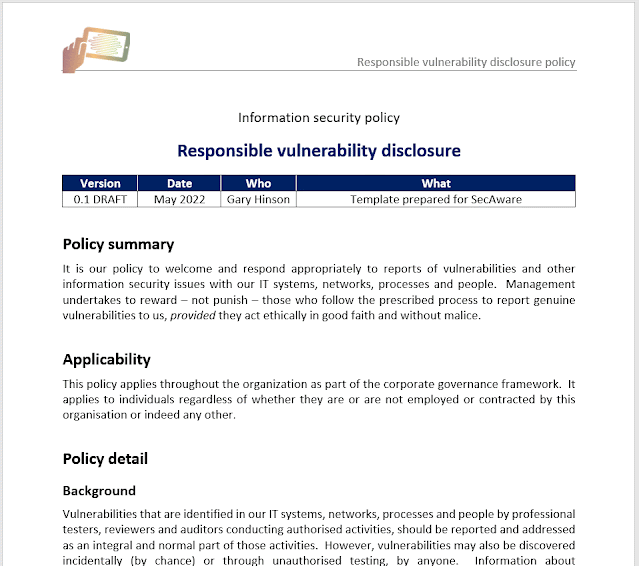
We have just completed and released another topic-specific information security policy template, covering responsible disclosure (of vulnerabilities, mostly). The policy encourages people to report any vulnerabilities or other information security issues they discover with the organisation's IT systems, networks, processes and people. Management undertakes to investigate and address reports using a risk-based approach, reducing the time and effort required for spurious or trivial issues, while ensuring that more significant matters are prioritised. The policy distinguishes authorised from unauthorised security testing, and touches on ethical aspects such as hacking and premature disclosure. It allows for reports to be made or escalated to Internal Audit, acting as a trustworthy, independent function, competent to undertake investigations dispassionately. This is a relief-valve for potentially sensitive or troublesome reports where the reporter is dubious of receiving fair, prompt t...