Posts

Showing posts with the label Vulnerability

Philosophical phriday - recovering from ransomware takes HOW long?!

Image
Recovering from a ransomware incident is costlier, more complicated and much slower that people commonly assume. "Just restore the backups and you're good to go, right?". Spoiler alert: restoring networks and IT systems from backups is only a fraction of this.  Here's a reasonably complete set of ransomware recovery activities that would normally led by general business and IT managers : Wake up and smell the coffee! Deal with the unfolding crisis and a degree of confusion. Invoke the crisis management process. Settle things down. Assemble the business incident management team. Invoke the incident management process. Form the IT incident management team. Contact insurers, law enforcement and security experts for guidance.

Information risk management - a worked example [LONG]

Image
In the past few days, I have been triggered yet again by someone fearing that ISO/IEC 27001 certification auditors may insist that various Annex A controls are applicable and must therefore be implemented for conformity. Apocryphal nightmares about auditors doing exactly that tend to stoke the fear and prolong the myth. Myth, yes, myth. I've said it before and no doubt I'll say it again: the Annex A information security controls are not formally required for conformity with the standard - none of them, not even one. If you or your auditors believe otherwise, kindly tell us which clause of the standard applies. What are the exact words leading to that conclusion? Spoiler alert: there are none. There is no such requirement. IT DOES NOT EXIST. There is , however, a conformity requirement to check through Annex A for any controls that might reduce otherwise untreated information risks, but even then there is no (repeat, no ) obligation to implement the controls as stated in A...

Philosophical phriday - countering outrageous misinformation

Image
For decades, I have appreciated  Peter Sandman 's approach to outrage - the social phenomenon in which groups of people react strongly to some perceived threat, issue, concern or whatever, drawing-in other like-minded individuals via social media. The echo chamber (positive feedback loop) can rapidly escalate emotions to an unreasonable degree with a lack of reasoned, critical thinking - according to those allegedly responsible for the issue anyway.    In the case of, say, the placing of 5G cell towers in/near schools, the outraged can become furious that the risk (as they see it) is being 'callously ignored' by the equipment suppliers, site developers, authorities and scientists, and enraged that they are 'not being taken seriously'. From their perspective,  thanks to group think (social endorsement),  the  perceived   risks are portrayed and understood to be deadly serious .  Leaders within the outraged community gain notoriety, influence and p...

Passionate dispassion

Image
Someone who is actively involved in, or is managing, an activity is patently not independent of it. They may well make a conscious, rational and determined effort to be objective, dispassionately reviewing evidence etc ., but their subconscious/emotional biases/prejudices and beliefs/value-systems will inevitably influence what they do. With the best will in the world, they will struggle to challenge and assess their past decisions and activities, especially if they were "certain" or "determined" or genuinely believed they were "doing the right thing". Furthermore, it is very hard for anyone to review the things they did not do, decisions they did not make or options they did not even consider. Mostly, they remain out of sight or out of the question.

Adaptive SME security Crowdstrike special

Image
As if on cue, along comes a golden opportunity to consider what the Adaptive SME security  approach has to say regarding the Crowdstrike incident: That's not 20/20 hindsight but foresight: I've picked out the most relevant rows from the security controls table published in the guide 24 hours before the incident.  Although Crowdstrike primarily supplies much larger enterprises than SMEs, the incident could equally have afflicted other security software, or indeed operating systems such as Windows and assorted cloud apps commonly used by SMEs. Regardless of the details, it is a wake-up call, an opportunity to consider and respond to the information risks ... and to adapt , accordingly.

Pro services under attack

Image
Among all the other bad news in the excellent Cy-Xplorer 2023 report from Orange Cyberdefense , this nugget of threat intelligence poked me in the eye: I've become increasingly concerned about the information risks relating to professional services in recent years. They seem obvious targets for malicious cyber attacks, given:

Risk quantification - other factors (UPDATED)

Image
The conventional focus of risk analysis is to examine the probability of incidents occurring, and their likely impacts if they do - and fair enough, those are obviously key factors ... but not the only ones. Add itional factors to consider include : Quality of information and analysis : risks that are commonplace and conventional are generally better understood than those which are novel or rare (such as AI risks, right now); Volatility : if the threats, vulnerabilities and business are reasonably stable, the risks are more easily determined/predicted than if they are volatile, changing unpredictably; Complexity : ugly, horrendously complicated risks are more likely to involve unrecognised interactions;

A round dozen risk treatment options

Image
I've been thinking about the 'treatment' phase of risk management lately. These are the four conventional and generally-accepted ways of treating (addressing) identified risks: Acceptance : living with the risk, hoping that it doesn't materialise; Avoidance : steering well clear of, or stopping, risky activities; Mitigation : reducing the probability and/or impact of incidents using various types of control;   Sharing : with others, such as business partners, insurers and communities. However, it occurs to me that a further eight risk treatment approaches are possible, whether you consider them alternatives, variants or complementary: Procrastination : delaying decisions and actions ostensibly in order to understand risks and possible treatment options (which, meanwhile, implies risk acceptance). Speedy decision-making is an important part of effective

Using ChatGPT more securely

Image
Clearly there are some substantial risks associated with using AI/ML systems and services, with some serious incidents having already hit the news headlines within a few months of the release of ChatGPT. However, having been thinking carefully and researching this topic for couple of weeks, I realised there are many more risks than the reported incidents might suggest, so  I've written up what I found. This pragmatic guideline explores the information risks associated with AI/ML,  from the perspective of an organisation whose workers are using ChatGPT (as an example) .   Having identified ~26 threats, ~6 vulnerabilities and dozens of possible impactful incident scenarios, I came up with ~20  information security controls capable of mitigating many of the risks. See what you make of it. Feedback welcome. What have I missed? What controls would you suggest? 

Ailien beacons warn of rocks ahead

Image
Lately, I've been contemplating how the widespread availability and use of AI might affect humankind - big picture stuff. We are currently awash in a tidal wave of commentary about AI innovation, the information risks of AI and its naive users, the tech, the ethics and compliance aspects, the inevitable grab by greedy big tech firms, misinformation, disinformation, jailbreaking and so on. Skimming promptly past well-meaning advisories about prompt engineering from people excited to share their discoveries, I've been reading pieces about how AI can support or will supplant all manner of expert advisors on any topic sufficiently well represented in the models and datasets. The likelihood (near certainty!) of AI-generated content feeding back into AI-data sets and hence the potential consequences of runaway hallucinations, coupled with deliberate manipulation by those with private agendas, is quite scary - but equally the possibility of AI generating new knowledge (valid and usefu...

To what extent do you trust the robots?

Image
This Sunday morning, fueled by two strong coffees, I'm cogitating on the issue of workers thoughtlessly disclosing all manner of sensitive personal or proprietary information in their queries to AI/ML/LLM systems and services run by third parties, such as ChatGPT. This is clearly topical given : (1) the deluge of publicity and chatter around ChatGPT right now, coupled with  (2) our natural human curiosity to explore new tech toys, plus  (3) limited appreciation of the associated information risks, and  (4) the rarity of controls such as policies and Data Leakage Protection technologies.  Furthermore, even if we do persuade our colleagues (and, let's be honest, ourselves!) to be more careful and circumspect about whatever we are typing or pasting into various online systems, the possibility remains that the general nature of our interests and queries is often sensitive.

Black hawk down ... but not out

Image
I've long been fascinated by the concept of 'resilience', and surprised that so many people evidently misunderstand and misrepresent it ... so please bear with me as I attempt to put the record straight by explaining my fascination. Resilience is not simply:  Being secure Being strong Recovering effectively, efficiently or simply recovering from incidents Avoiding or mitigating incidents Any specific technical approach or system Any particular human response, action or intent A backstop or ultimate control Heroic acts A construct, something we design and build Something that can simply be mandated or demanded Specific to particular circumstances, situations or applications It's bigger than any of those - in fact bigger than all of them, combined. Resilience is all of those, and more ... Resilience is : A general concept, a philosophy, a belief An engineering and architectural approach

Vulnerability is ...

Image
... " an inherent and potentially exploitable weakness in an information asset, system, process, organisation etc."   [source:  SecAware glossary ] ... exposed by one or more missing, ineffective or inadequate  controls ... “a security weakness in a computer” [source:  NIST SP800-114 rev1 ] ... “a weakness, susceptibility or flaw of an asset or control that can  be exploited by one or more threats” [source: Financial Stability Board  Cyber Lexicon ] ... "weakness of an asset or  control  that can be exploited by one or more  threats ”  [source:  ISO/IEC 27000 ] ... "weakness in a system, system security procedures, internal controls, or implementation that could be exploited or triggered by a threat" [source:  NIST SP 1800-17b ] ... a chink in the armour ... a gap in our defences ... revealed in incidents ... asking for trouble ... taking a chance ... misplaced trust ... the wea...

Security awareness month

Image
Since October is cybersecurity awareness month in the USA, we've seized the opportunity to update SecAware.com with additional information on our security awareness material.  SecAware's information security awareness modules explore a deliberately wide variety of individual topics in some depth:

Complete security is an oxymoron

Image
An interesting Kiwi business startup caught my beady eye today. Without being too specific, they are offering a financial service, making me curious about the legal and regulatory hoops they presumably had to clear in order to do so . Checking their shiny new website hasn't exactly inspired me with confidence. The home page claims to be using a completely secure platform ... which is, I suspect, a bit of a porky, an exaggeration, stretching the truth. Maybe they have been carried away by their own marketing. Perhaps they are just naive. I have never come across a totally secure system, and seriously doubt there is such a beast. Sure, I've dealt with many highly secure systems, all of which were vulnerable in various ways. None of the organisations concerned had the nerve to claim they were totally secure however, since (with a little guidance from pro's like me!) management accepted that there were residual risks, despite all our efforts.  Paradoxically, by claiming total s...

Ten tips on tackling a thorny infosec issue

Image
A member approached the  ISO27k Forum   this morning for advice: " What would you recommend to do if our warnings as ISMS department specialists/auditors are not taken into account?" What can realistically be done if  management isn't paying sufficient attention to information risks that we believe are significant ?  This is a thorny issue and not an uncommon challenge, particularly among relatively inexperienced or naïve but eager information risk and security professionals, fresh out of college and still studying hard for their credentials. It can also afflict the greybeards among us: our passion for knocking down information risks can overtake our abilities to convince managers and clients. Here are ten possible responses to consider: 

Security in software development

Image
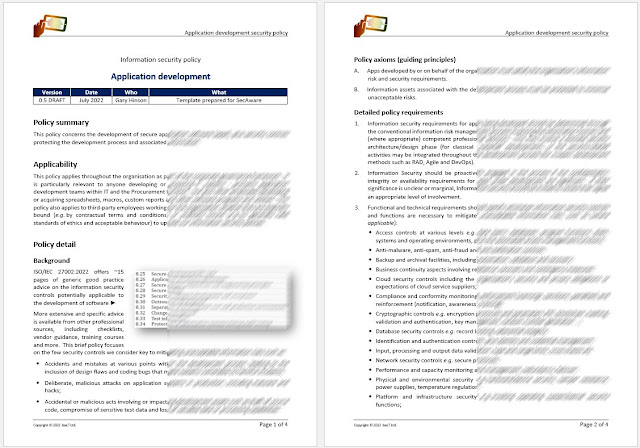
Prompted by some valuable customer feedback earlier this week, I've been thinking about how best to update the SecAware policy template on software/systems development. The customer is apparently seeking guidance on integrating infosec into the development process, which begs the question "Which development process?". These days, we're spoilt for choice with quite a variety of methods and approaches.  Reducing the problem to its fundamentals, there is a desire to end up with software/systems that are 'adequately secure', meaning no unacceptable information risks remain. That implies having systematically identified and evaluated the information risks at some earlier point, and treated them appropriately - but how? The traditional waterfall development method works sequentially from business analysis and requirements definition, through design and development, to testing and release - often many months later. Systems security ought to be an integral part of th...

Responsible disclosure - another new policy

Image
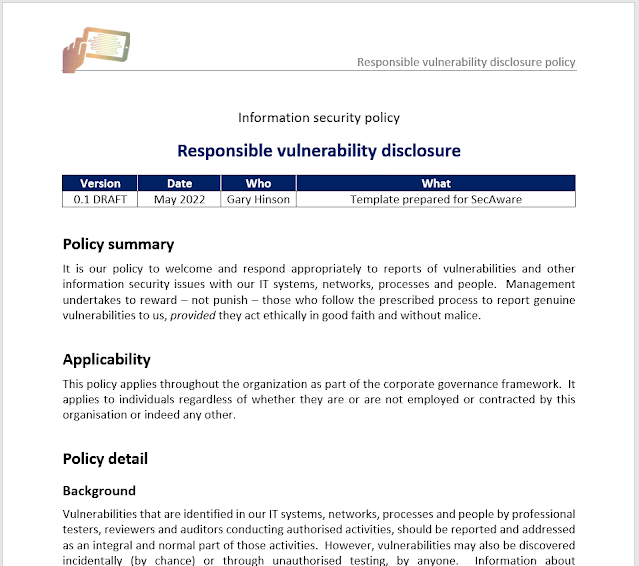
We have just completed and released another topic-specific information security policy template, covering responsible disclosure (of vulnerabilities, mostly). The policy encourages people to report any vulnerabilities or other information security issues they discover with the organisation's IT systems, networks, processes and people. Management undertakes to investigate and address reports using a risk-based approach, reducing the time and effort required for spurious or trivial issues, while ensuring that more significant matters are prioritised. The policy distinguishes authorised from unauthorised security testing, and touches on ethical aspects such as hacking and premature disclosure. It allows for reports to be made or escalated to Internal Audit, acting as a trustworthy, independent function, competent to undertake investigations dispassionately. This is a relief-valve for potentially sensitive or troublesome reports where the reporter is dubious of receiving fair, prompt t...

Professional services - preliminaries

Image
Yesterday I proposed a guideline on the information risk, security and privacy aspects of professional services . I introduced a simplistic 3-phase model for the business relationship through which one or more professional services assignments are delivered and consumed.  Today, I'm exploring the preliminary phase. Before professional services are delivered, client and provider form a business relationship. They determine the professional services required and offered, and of course negotiate the commercial arrangements. They also have the opportunity to decide how the services are to be provided, and how both the assignment/s and the business relationship are to be managed. Contracting is an important control in its own right with significant information and commercial risks associated. The contract may for instance: Be inappropriate for either organisation, the relationship and/or the professional service/s;  Be informal, undocumented, invalid and hence unenforceable; Bypass...

An important lesson from the Farcebook Fiasco 2021

Image
I gather from friends and the news media that there was an unplanned outage earlier this week at Facebook. I'm told that Facebook is a fairly popular social media platform - some have said addictive. As you can no doubt tell, I don't see the attraction and I'm definitely not hooked. If it weren't for the brouhaha, I wouldn't have even noticed, let alone worried or written about it. I understand the outage was caused by a technical issue in the network - something to do with the BGP configuration. I'm not particularly interested in, and probably wouldn't even understand, the details. The self same issue locked Facebook's IT administrators out of their own systems, leaving them cut off and unable to address/reverse/fix the issue for several hours, causing mild panic and a little outrage among its users, customers and other stakeholders. The same issue took down related websites too. Doubtless the admins were stressed out, possibly frantic, while their mana...