Posts

Showing posts with the label Cloud

Adaptive SME security Crowdstrike special

Image
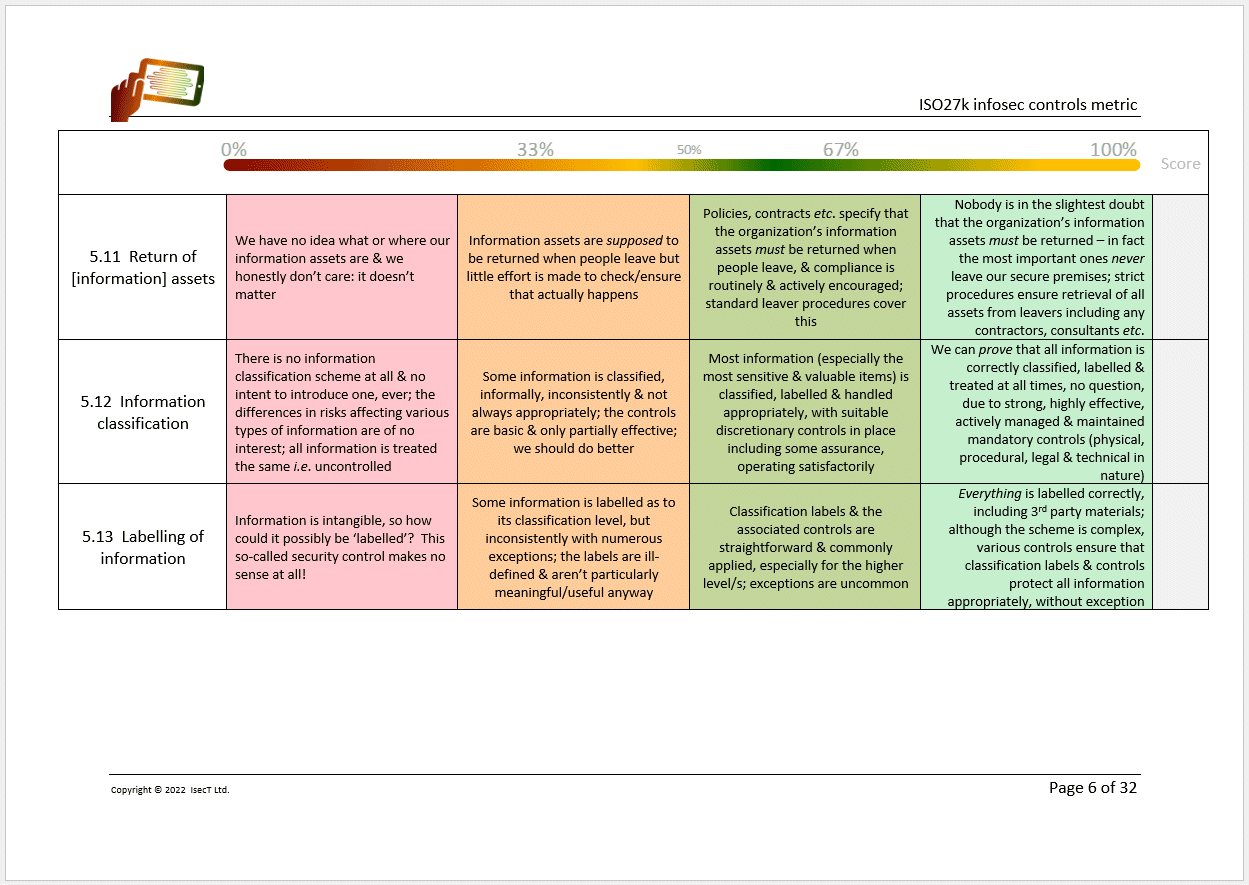
As if on cue, along comes a golden opportunity to consider what the Adaptive SME security  approach has to say regarding the Crowdstrike incident: That's not 20/20 hindsight but foresight: I've picked out the most relevant rows from the security controls table published in the guide 24 hours before the incident.  Although Crowdstrike primarily supplies much larger enterprises than SMEs, the incident could equally have afflicted other security software, or indeed operating systems such as Windows and assorted cloud apps commonly used by SMEs. Regardless of the details, it is a wake-up call, an opportunity to consider and respond to the information risks ... and to adapt , accordingly.

BCM for WFH

Image
Since home and mobile workers rely on IT to access critical business systems and corporate data, and to communicate with others, organisations need a robust IT network infrastructure that extends to workers' homes or wherever they hang out. If, in reality, the infrastructure turns out to be fragile and unreliable, business activities are likely to be equally fragile and unreliable, leading to frustration and grief all round. In other words, the extended IT infrastructure is quite likely business-critical. W orking F rom H ome or on the road can increase various information risks relative to conventional office-based work, due to factors such as: Use of cloud computing services*; Workers using their own or shared devices and internet connections for work purposes, raising questions about their suitability and security, ownership of and access to any intellectual property or personal information on them;

Using ChatGPT more securely

Image
Clearly there are some substantial risks associated with using AI/ML systems and services, with some serious incidents having already hit the news headlines within a few months of the release of ChatGPT. However, having been thinking carefully and researching this topic for couple of weeks, I realised there are many more risks than the reported incidents might suggest, so  I've written up what I found. This pragmatic guideline explores the information risks associated with AI/ML,  from the perspective of an organisation whose workers are using ChatGPT (as an example) .   Having identified ~26 threats, ~6 vulnerabilities and dozens of possible impactful incident scenarios, I came up with ~20  information security controls capable of mitigating many of the risks. See what you make of it. Feedback welcome. What have I missed? What controls would you suggest? 

COVID information risk analysis - retrospective

Image
Two and a half years ago in March 2020 as we were fast approaching our first lockdown, I published the following P robability I mpact G raph depicting my analysis of the information risks relating to COVID: The PIG reports the information risks I identified at the time, thinking about COVID from the general societal perspective as opposed to a personal or organisational perspective.

Skyscraper of cards

Image
Having put it off for far too long, I'm belatedly trying to catch up with some standards work in the area of R oot o f T rust, which for me meant starting with the basics, studying simple introductory articles about RoT. As far as I can tell so far, RoT is a concept -  the logical basis, the foundation on which secure IT systems are built. 'Secure IT systems' covers a huge range. At the high end are those used for national security and defence purposes, plus safety- and business-critical systems facing enormous risks (substantial threats and impacts). At the low end are systems where the threats are mostly accidental and the impacts negligible - perhaps mildly annoying. Not being able to tell precisely how many steps you've taken today, or being unable to read this blog, is hardly going to stop the Earth spinning on its axis. In fact' mildly' may be overstating it. 'Systems' may be servers, desktops, portables and wearables, plus IoT things and all mann...

ISO/IEC 27002 update

Image
The newly-published third edition of ISO/IEC 27002 is a welcome update to the primary ISO27k controls catalogue (officially, a 'reference set of generic information security controls').  Aside from restructuring and generally updating the controls from the 2013 second edition, the committee (finally!) seized the opportunity to beef-up the coverage of information security for cloud computing with new control 5.23, plus ten other new controls, mostly in section 8 (technological controls):   Configuration management (8.9) - concerns the need to manage security and other configuration details for [IT] hardware, software, [information] services and networks. Data leakage prevention (8.12) - DLP is required to protect sensitive information against unauthorized disclosure/extraction (theft, surveillance). Data masking (8.11) - in line with the organisation’s access control policy, plus other business requirements and compliance obligations, scurity controls are apropriate to mitig...

Weaving strategies with policies

Image
I mentioned recently here on the blog that there can be strategic elements to policies, just as there are operational aspects to the supporting procedures and guidelines. With the new year fast approaching, I'd like to explore that further today. Warning : your blinkers are coming off. Prepare for the glare. Take for instance the corporate responses to COVID-19. Out of necessity, organisations in lockdown shifted rapidly from on-site office work and in-person meetings to home-working, using video conferencing, email and collaborative approaches. Although that may have been a purely reactive, un-pre-planned response to the global crisis that erupted (despite prior pandemics and warnings arising from increasing international travel) , it was facilitated by longer-term planned, strategic changes and investments in a resilient workforce with flexible working practices and positive attitudes, strong relationships within and without the organisation, plus appropriate tools and technolog...

An important lesson from the Farcebook Fiasco 2021

Image
I gather from friends and the news media that there was an unplanned outage earlier this week at Facebook. I'm told that Facebook is a fairly popular social media platform - some have said addictive. As you can no doubt tell, I don't see the attraction and I'm definitely not hooked. If it weren't for the brouhaha, I wouldn't have even noticed, let alone worried or written about it. I understand the outage was caused by a technical issue in the network - something to do with the BGP configuration. I'm not particularly interested in, and probably wouldn't even understand, the details. The self same issue locked Facebook's IT administrators out of their own systems, leaving them cut off and unable to address/reverse/fix the issue for several hours, causing mild panic and a little outrage among its users, customers and other stakeholders. The same issue took down related websites too. Doubtless the admins were stressed out, possibly frantic, while their mana...

News on ISO/IEC 27002

Image
Today I’ve slogged my way through a stack of ~50 ISO/IEC JTC1/SC27 emails, updating a few ISO27001security.com pages here and there on ongoing standards activities. The most significant thing to report is that the project to revise the 3 rd  (2013) edition of ISO/IEC 27002 appears on-track to reach final draft stage soon and will hopefully be approved this year, then published soon after (during 2022, I guess).    The standard is being extensively restructured and updated, collating and addressing about 300 pages of comments from the national standards bodies at every stage.  The editorial team are doing an amazing job!   The new ‘27002 structure will have the controls divided into 4 broad categories or types i.e.  technical, physical, people and ‘organizational’ [=other]: For comparison, the standard is currently structured into 13 security domains: ‘27002 will nearly double in size, going from 90 to 160 pages or so, thanks to new controls and...

Y2k + 20: risk, COVID and "the Internet issue"

Image
It feels like 'just the other day' to me but do you recall "Y2k" and all that?  Some of you reading this weren't even born back then, so here's a brief, biased and somewhat cynical recap. For a long time prior to the year 2000, a significant number of software programmers had taken the same shortcut we all did  back in "the 90s". Year values were often coded with just two decimal digits: 97, 98, 99 ... then 00, "coming ready or not!". "Oh Oh" you could say. "OOps". When year counters went around the clock and reset to zero, simplistic arithmetic operations (such as calculating when something last happened, or should next occur) would fail causing ... well, potentially causing issues, in some cases far more significant than others. Failing coke can dispensers and the appropriately-named Hornby Dublo train sets we could have coped with but, trust me, you wouldn't want your heart pacemaker, new fangled fly-by-wire plan...

Is Facebook an asset?

Image
Yet another good question came up on the ISO27k Forum today*. Someone asked whether to add the company's Facebook page to their information asset register (implying that it would need to be risk-assessed and secured using the Information Security Management System processes), or whether the asset should be the Facebook account (ID and password, I guess)**. From the marketing/corporate perspective, good customer relations are perhaps the most valuable information assets of all, along with other external relations ( e.g. your suppliers, partners, prospective and former customers, regulators/authorities and owners) and internal relations (the workforce, including staff, management, contractors, consultants and temps, plus former and prospective workers). It’s tempting to think of these as just categories or faceless corporations, but in reality the interactions are between individual human beings, so social relations  in general are extremely important in business.  ...

Of APTs and RPTs

Image
Do you recall when APTs were A Thing? A dvanced P ersistent T hreats were exemplified by Stuxnet , a species of malware that was stealthy enough to penetrate the defences of an Iranian nuclear fuel processing plant ten years ago, persistent enough to undermine numerous layers of control, and sophisticated enough to over-speed and wreck the centrifuges without alerting the plant operators until the damage was done.   We seldom hear of weapons-grade APTs these days, suggesting they are no longer newsworthy or effective. Maybe they have gone the way of the trebuchet or musket ... but I believe it's much more likely that APTs have become even more sophisticated, stealthier and more damaging now than ever before, especially given the ascendance of IoT, IIoT and 'cyber-physical systems'. Now, Things are A Thing. Meanwhile, we are frequently  constantly assaulted by ordinary, conventional, old-school malware - R etarded P ersistent T hreats as it were. In contrast to APTs, RPTs ...

March 20 - COVID-19 PIG update

Image
Here's today's update to my COVID-19 information risk P robability I mpact G raphic: I've slightly shifted and revised the wording of some of the risks but there's nothing really new (as far as I know anyway).  Reports of panic buying from the UK and US are concerning, given the possible escalation to social disorder and looting … but hopefully sanity will soon return, aided by the authorities promoting “social distancing” and “self-isolation”.   Meanwhile, I hope those of you responsible for physically securing corporate premises have appropriate security arrangements in place. Remotely monitored alarms and CCTV are all very well, but what if the guards that would be expected to do their rounds and respond to an incident are off sick or isolated at home? Do you have contingency arrangements for physical security? ‘Sanity’ is a fragile condition: there is clearly a lot of anxiety, stress and tension around, due to the sudden social changes, fear about the infectious dis...

March 18 - COVID-19 PIG update

Image
I've updated the PIG showing information risks relating to COVID-19, originally published here five days ago:  Two additional information risks now feature in the middle: Mental health issues arising from the sudden widespread introduction of work-from-home, social distancing, cancellation of many leisure activities etc., on top of the stress of potentially being infected and becoming sick. Laid-off workers are basically cast adrift, placing them under immense personal stress at this difficult time because of the scale of COVID-19: they are unlikely to walk directly into their next contract or permanent role with some other organisation if everyone is in crisis. Remaining workers may have 'survivor guilt', and fear also being laid off - hardly conducive to productive working. It may  increase 'insider threats'. Also, this risk may increase over time once we get beyond the honeymoon period as workers settle in to their more isolated workspaces, and face up to the r...

A live case study

Image
As we slave away on next month's security awareness module on malware, the Travelex ransomware incident rumbles on - a gift of a case study for us, our customers and for other security awareness pro's out there. A quick glance at Travelex dotcom  tells us that (as of this blogging) the incident is ongoing, unresolved, still a public embarrassment to Travelex that is presumably harming their business and their brand ... although having said that I've already mentioned their name three times in this piece. If you believe 'there's no such thing as bad publicity', then headline stories about the incident are all good, right? Hmmm, leave that thought with me. Meanwhile, for the remainder of this piece, I'll call them "Tx" for short. Technically speaking, the Tx dotcom website is up and running, serving a simple information page 'apologising for any inconvenience' [such as retail customers being unable to use the site to access Tx financial serv...

A dozen infosec strategies (amended x2)

Image
This Sunday morning, further to my tips on planning for 2020, prompted by " 5 disruptive trends transforming cybersecurity " and fueled by some fine Columbian (coffee not coke!), I've been contemplating information risk and security strategies. Here's a dozen generic strategic approaches to consider: Use risk to drive security.   Instead of vainly hoping to address every risk, hammer the biggest ones, tap at the middling ones and let the little'uns fend for themselves (relying on general purpose controls such as incident and business continuity management, resilience etc .).   'Hammer the biggest' means going the extra mile for 'key' or 'critical' controls addressing 'key' or 'major' or 'bet the farm' risks, and implies substantial effort to identify, understand and evaluate the risks, as well as actually dealing with them. Make security processes as slick as possible, using automation, simplicity, repeatability etc ...

Teflon-coated security

Image
An article about hackers compromising IoT things mentions that IoT manufacturers choose not to make their devices more secure because the additional security controls would create 'friction' for users - in other words, they are making explicit commercial decisions about their products that take into account usability as well as various other factors, such as security, privacy and I guess cost. Well, who'd a thunk it?  Information risk and security management is all about making compromises and trade-offs. There are numerous options and decisions to be made, plus situations that are forced upon us. Re 'friction', it occurs to me that effective security awareness smooths the way for additional/better security . Once people such as the concerned mother in the article, and hopefully some of its readers, appreciate the need for and value of security, they are more likely to accept the cost of security - not just the slight increase in the price of things  for additional...