Posts

Showing posts with the label Confidentiality

Book review: Permanent Record by Ed Snowden

Image
Title: Permanent Record Author: Edward Snowden ISBN: 978-1-250-23723-1 Price: US$18 from Amazon GH rating: 90% Summary Until I read this book, I considered my personal integrity a fundamental strength, core to my very being. It pales in comparison to Ed's extreme courage and intense determination to expose the shocking truth about the NSA's mass surveillance programme and the way it was concealed from Congress.

eWaste safety hazards and information risks

Image
A warning in the New Zealand Information Security Manual  caught my beady eye yesterday: “Electrical and electronic equipment contains a complex mix of materials, components and substances, many which can be poisonous, carcinogenic or toxic in particulate or dust form. Destruction and disposal of WEEE [Waste from Electrical and Electronic Equipment] needs to be managed carefully to avoid the potential of serious health risk or environmental hazard.” Disposing of eWaste presents environmental and safety hazards arising from noxious/toxic/carcinogenic chemicals such as gallium arsenide (GaAs) and polychlorinated biphenyls (PCBs), plus the obvious dangers when handling sharp-edged metal or plastic chassis fragments, wires, printed circuit boards and CD/DVD discs plus  leaky electrolytic capacitors and old batteries . While there may be money to be made by extracting and recycling valuable metals  and reusable components ,  subsystems and modules , that's really a jo...

Using ChatGPT more securely

Image
Clearly there are some substantial risks associated with using AI/ML systems and services, with some serious incidents having already hit the news headlines within a few months of the release of ChatGPT. However, having been thinking carefully and researching this topic for couple of weeks, I realised there are many more risks than the reported incidents might suggest, so  I've written up what I found. This pragmatic guideline explores the information risks associated with AI/ML,  from the perspective of an organisation whose workers are using ChatGPT (as an example) .   Having identified ~26 threats, ~6 vulnerabilities and dozens of possible impactful incident scenarios, I came up with ~20  information security controls capable of mitigating many of the risks. See what you make of it. Feedback welcome. What have I missed? What controls would you suggest? 

To what extent do you trust the robots?

Image
This Sunday morning, fueled by two strong coffees, I'm cogitating on the issue of workers thoughtlessly disclosing all manner of sensitive personal or proprietary information in their queries to AI/ML/LLM systems and services run by third parties, such as ChatGPT. This is clearly topical given : (1) the deluge of publicity and chatter around ChatGPT right now, coupled with  (2) our natural human curiosity to explore new tech toys, plus  (3) limited appreciation of the associated information risks, and  (4) the rarity of controls such as policies and Data Leakage Protection technologies.  Furthermore, even if we do persuade our colleagues (and, let's be honest, ourselves!) to be more careful and circumspect about whatever we are typing or pasting into various online systems, the possibility remains that the general nature of our interests and queries is often sensitive.

Information risks a-gurgling

Image
There are clearly substantial information risks associated with the redaction of sensitive elements from disclosed reports and other formats, risks that the controls don't necessarily fully mitigate. Yes, controls are fallible and constrained, leaving residual risks. This is hardly Earth-shattering news to any competent professional or enlightened infidel, and yet others are frequently shocked.  A new report* from a research team at the University of Illinois specifically concerns failures in the redaction processes and tools applied to  PDF documents . The physical size of redacted text denoted (covered or replaced) with a variable-length black rectangle may give clues as to the original content, while historically a disappointing number of redaction attempts have failed to prevent the original information being recovered simply by removing the cover images or selecting then pasting the underlying text. Doh!

Learning points from a 27001 certification announcement

Image
This morning I bumped into a marketing/promotional piece announcing PageProof’s certified "compliance" (conformity!) with "ISO 27001" (ISO/IEC 27001!). Naturally, they take the opportunity to mention that information security is an integral part of their products. The promo contrasts SOC2 against '27001 certification, explaining why they chose ‘27001 to gain some specific advantages such as GDPR compliance - and fair enough. In the US, compliance is A Big Thing. I get that. It occurs to me, though, that there are other, broader advantages to ‘27001 which the promo could also have mentioned, further valuable benefits of their newly-certified ISMS.

Hacking the Microsoft Sculpt keyboard

Image
In its infinite wisdom, Microsoft designed data encryption into the Sculpt wireless keyboard set to protect against wireless eavesdropping and other attacks. The keyboard allegedly* uses AES for symmetric encryption with a secret key burnt into the chips in the keyboard's very low power radio transmitter and the matching USB dongle receiver during manufacture: they are permanently paired together. The matching Sculpt mouse and Sculpt numeric keypad use the same dongle and both are presumably keyed and paired in the same way as the keyboard. This design is more secure but less convenient than, say, Bluetooth pairing. The risk of hackers intercepting and successfully decoding my keypresses wirelessly is effectively zero. Nice! Unfortunately, the keyboard, keypad and mouse are all utterly dependent on the corresponding USB dongle, creating an availability issue. Being RF-based, RF jamming would be another availability threat. Furthermore, I'm still vulnerable to upstream and downs...

AA privacy breach -- policy update?

Image
According to a Radio New Zealand news report today: "Hackers have taken names, addresses, contact details and expired credit card numbers from the AA Traveller website used between 2003 and 2018. AA travel and tourism general manager Greg Leighton said the data was taken in August last year and AA Traveller found out in March. He said a lot of the data was not needed anymore, so it should have been deleted, and the breach "could have been prevented"." The disclosure prompted the acting NZ Privacy Commissioner to opine that companies 'need a review policy': "Acting Privacy Commisioner Liz Macpherson told Midday Report that if data was not needed it should be deleted ... Companies needed a review policy in place to determine if the data stored was neccessary, or could be deleted, Macpherson said." So I've looked through our SecAware information security policies to see whether we have it covered already, and sure enough we do - well, sor...

Data masking and redaction policy

Image
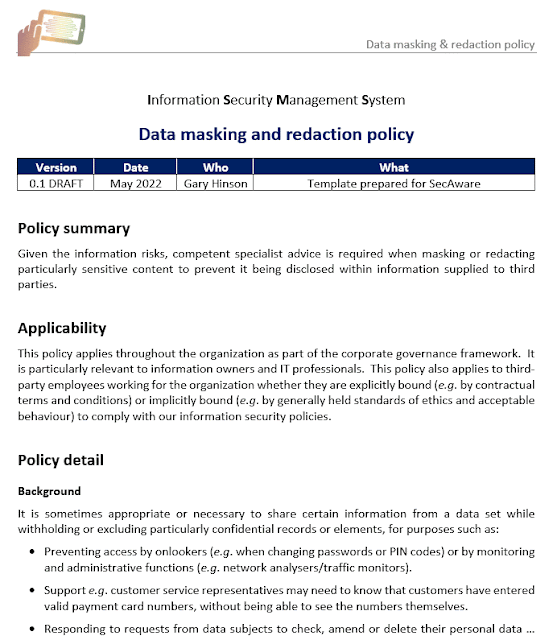
  Last evening I completed and published another SecAware infosec policy template addressing ISO/IEC 27002:2022 clause 8.11 "Data masking": "Data masking should be used in accordance with the organization’s topic-specific policy on access control and other related topic-specific, and business requirements, taking applicable legislation into consideration." The techniques for masking or redacting highly sensitive information from electronic and physical documents may appear quite straightforward. However, experience tells us the controls are error-prone and fragile: they generally fail-insecure, meaning that sensitive information is liable to be disclosed inappropriately. That. in turn, often leads to embarrassing and costly incidents with the possibility of prosecution and penalties for the organisation at fault, along with reputational damage and brand devaluation. The policy therefore takes a risk-based approach, outlining a range of masking and redaction controls...

Professional services - concluding phase

Image
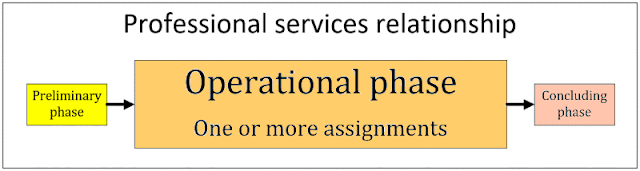
Having introduced this blog series and covered information risks applicable to the preliminary and operational phases of a professional services engagement, it's time to cover the third and final phase when the engagement and business relationship comes to an end. Eventually, all relationships draw to a close. Professional services clients and providers go their separate ways, hopefully parting on good terms unless there were unresolved disagreements, issues or incidents (hinting at some information risks). It is worth considering what will/might happen at the end of a professional services engagement as early as the preliminary pre-contract phase. Some of the controls need to be predetermined and pre-agreed in order to avoid or mitigate potentially serious risks later-on. Straightforward in principle ... and yet easily neglected in the heady rush of getting the engagement going. This is not unlike a couple drawing up their "pre-nup" before a wedding, or a sensible organi...

Professional services - preliminaries

Image
Yesterday I proposed a guideline on the information risk, security and privacy aspects of professional services . I introduced a simplistic 3-phase model for the business relationship through which one or more professional services assignments are delivered and consumed.  Today, I'm exploring the preliminary phase. Before professional services are delivered, client and provider form a business relationship. They determine the professional services required and offered, and of course negotiate the commercial arrangements. They also have the opportunity to decide how the services are to be provided, and how both the assignment/s and the business relationship are to be managed. Contracting is an important control in its own right with significant information and commercial risks associated. The contract may for instance: Be inappropriate for either organisation, the relationship and/or the professional service/s;  Be informal, undocumented, invalid and hence unenforceable; Bypass...

Infosec policy development

Image
We're currently preparing some new information risk and security policies for SecAware.com .  It's hard to find gaps in the suite of ~80 policy templates already on sale  (!) but we're working on these four additions: Capacity and performance management : usually, an organization's capacity for information processing is managed by specialists in IT and HR.  They help general management optimise and stay on top of information processing performance too.  If capacity is insufficient and/or performance drops, that obviously affects the availability of information ... but it can harm the quality/ integrity and may lead to changes that compromise confidentiality , making this an information security issue.  The controls in this policy will include engineering, performance monitoring, analysis/projection and flexibility, with the aim of increasing the organisation's resilience. It's not quite as simple as 'moving to the cloud', although that may be part of the...

Who's for a Pimms?

Image
Within a year or so, organisations will be able to have their P rivacy I nformation M anagement S ystems certified compliant with ISO/IEC 27701 , thanks to a new accreditation standard ISO/IEC TS 27006 part 2 , currently in draft. A PIMS is very similar to an I nformation S ecurity M anagement S ystem, hence compliance auditing and certification are also very similar – so much so that I’ve heard some certification bodies are already taking the initiative by issuing PIMS certificates despite their not being formally accredited for that. Potentially, a PIMS certificate may become the generally-accepted means of demonstrating an organisation’s due care over privacy and personal data protection – a way to assure data subjects, business partners, the authorities and courts that they have, in fact, adopted good privacy practices.  A PIMS should materially reduce an organisation’s risk of suffering privacy breaches.   However, as with an ISMS, ‘materially reduce’ is not quite t...