Posts

Showing posts with the label Bugs

Crowdstrike - post-incident review: a dozen learning points

Image
I blogged about the Crowdstrike incident on July 21st  while it was still playing out. Now, having  d rained the swamp and let the d ust settle, I'm  d ue to d raw out, d econstruct and d ecide what to d o about the Crowdstrike d isaster, so here goes: Design, build and test systems for resilience, where 'systems' means not just IT systems but the totality of interdependent technologies, organisations, people, information flows and other resources necessary to deliver and support critical business activities. Hinson tip : "be prepared" is not just for  boy scouts ! Those dependencies are p otential p inch p lus  p ain p oints. Test software before release. Sounds easy, right? It isn't. There is an infinite amount of testing that could be performed, only a fraction of which realistically should be, while the amount and quality of testing actually performed is resource-constrained and time-boxed for business and uncertainty (risk!) reasons (delaying secu...

Information risks a-gurgling

Image
There are clearly substantial information risks associated with the redaction of sensitive elements from disclosed reports and other formats, risks that the controls don't necessarily fully mitigate. Yes, controls are fallible and constrained, leaving residual risks. This is hardly Earth-shattering news to any competent professional or enlightened infidel, and yet others are frequently shocked.  A new report* from a research team at the University of Illinois specifically concerns failures in the redaction processes and tools applied to  PDF documents . The physical size of redacted text denoted (covered or replaced) with a variable-length black rectangle may give clues as to the original content, while historically a disappointing number of redaction attempts have failed to prevent the original information being recovered simply by removing the cover images or selecting then pasting the underlying text. Doh!

Security in software development

Image
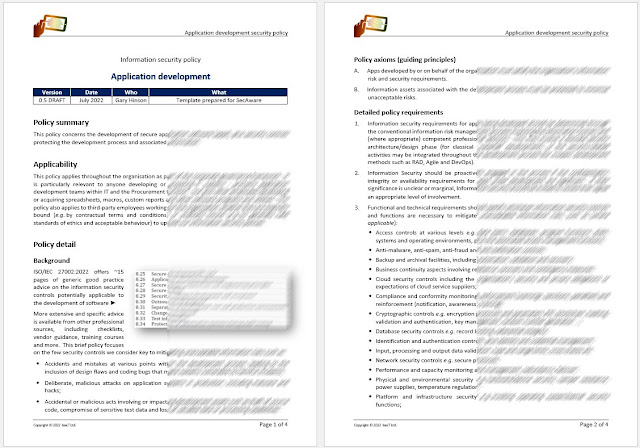
Prompted by some valuable customer feedback earlier this week, I've been thinking about how best to update the SecAware policy template on software/systems development. The customer is apparently seeking guidance on integrating infosec into the development process, which begs the question "Which development process?". These days, we're spoilt for choice with quite a variety of methods and approaches.  Reducing the problem to its fundamentals, there is a desire to end up with software/systems that are 'adequately secure', meaning no unacceptable information risks remain. That implies having systematically identified and evaluated the information risks at some earlier point, and treated them appropriately - but how? The traditional waterfall development method works sequentially from business analysis and requirements definition, through design and development, to testing and release - often many months later. Systems security ought to be an integral part of th...

Of APTs and RPTs

Image
Do you recall when APTs were A Thing? A dvanced P ersistent T hreats were exemplified by Stuxnet , a species of malware that was stealthy enough to penetrate the defences of an Iranian nuclear fuel processing plant ten years ago, persistent enough to undermine numerous layers of control, and sophisticated enough to over-speed and wreck the centrifuges without alerting the plant operators until the damage was done.   We seldom hear of weapons-grade APTs these days, suggesting they are no longer newsworthy or effective. Maybe they have gone the way of the trebuchet or musket ... but I believe it's much more likely that APTs have become even more sophisticated, stealthier and more damaging now than ever before, especially given the ascendance of IoT, IIoT and 'cyber-physical systems'. Now, Things are A Thing. Meanwhile, we are frequently  constantly assaulted by ordinary, conventional, old-school malware - R etarded P ersistent T hreats as it were. In contrast to APTs, RPTs ...

Adjusting to the new normal

Image
According to alert AA20-133A from US-CERT : "The U.S. Government has reported that the following vulnerabilities are being routinely exploited by sophisticated foreign cyber actors in 2020: Malicious cyber actors are increasingly targeting unpatched Virtual Private Network vulnerabilities. An arbitrary code execution vulnerability in Citrix VPN appliances, known as CVE-2019-19781, has been detected in exploits in the wild. An arbitrary file reading vulnerability in Pulse Secure VPN servers, known as CVE-2019-11510, continues to be an attractive target for malicious actors. March 2020 brought an abrupt shift to work-from-home that necessitated, for many organizations, rapid deployment of cloud collaboration services, such as Microsoft Office 365 (O365). Malicious cyber actors are targeting organizations whose hasty deployment of Microsoft O365 may have led to oversights in security configurations and vulnerable to attack. ...

Neat and tidy

Image
My perfectionist streak flared up with a vengeance today. First I spent a productive couple of hours checking and revising the content of our generic/model  A cceptable U se P olicies, intending to include them in the updated  Information Security 101   materials.  Aside from reviewing and tinkering with the information content , this also involved standardising the formatting of the AUPs by using the same MS Word template with specific styles for all of them. The AUPs have been updated at various times in various awareness modules and I noticed that, somewhere along the way, I must have changed the bullets and colouring for the 'acceptable use' and 'unacceptable use' points. Evidently I have also meddled with the boilerplate text that tops and tails each AUP, making them slightly inconsistent. To my beady eye,  this will not do!   Unsure how to name the model AUP files, I toyed with the idea of making a single multi-page document containing them all b...

Awareness module on hackers and hacking

Image
We've just completed and delivered  our security awareness and training module about hackers - a topic we haven’t covered specifically for a few years, although most of the awareness modules at least touch on hacking – some more than others, The hacking risks have changed perceptibly in that time. The rise of state-sponsored (spooky!) hacking is of great concern to those of us who care about critical national infrastructures, human society and world peace. The United Nations is due to meet in a couple of weeks to discuss the possibility of reaching agreement on the rules of cyberwarfare, mirroring those for conventional, nuclear and biological warfare. Let’s hope they manage to align the ~200 countries represented at the UN – a tough task for the diplomats, politicians and cyberwar experts. That aspect gives a distinctly sinister tinge to the awareness module, and yet I hope we’ve succeeded in keeping the materials reasonably light, interesting and engaging as ever, a del...

The compliance burden

Image
I've spent an enjoyable day exploring, thinking and writing about the enormous breadth of "compliance", our security awareness topic for July.  You might be forgiven for thinking that compliance in this context is just about hacking and privacy laws, but no, oh no: important though those are, there's much more to it. We have thus far compiled a list of 15 categories of law relevant in some way to information security - not just 15 actual laws but 15 types .  There's a similar range of regulations, plus contracts and agreements. No wonder corporate lawyers, compliance teams and management as a whole complain about the compliance burden on businesses! On top of that there are myriad internal corporate rules in the form of infosec-related policies, procedures and all that jazz - again, quite a variety when you think about it.  And we all have self-imposed rules of behavior - our habits and conventions, codes of ethics, belief systems, rules for what's right and ...

Real-world physical impacts

Image
At the moment, as currently scoped, June's awareness module primarily concerns physical security measures protecting information, data and IT systems, including health and safety protection for workers ... but there's another aspect that potentially falls in scope: IT incidents with physical real-world impacts . Thus far, fortunately, such incidents have been very rare, mostly proof-of-concept demonstrations that hacking, say, the IT systems controlling an electricity generator could indeed cause it to liberate the smoke . The potential is very real and scary however once you appreciate just how much of modern life is controlled by vulnerable computers, often Internetworked, with design flaws and bugs mostly tucked out of sight, lurking in the extreme technical complexities under the hood. There be dragons, as the Iranians discovered . The proliferation and interconnectedness of IT systems has reached epic proportions lately with Internet-connected lightbulbs, air conditioners,...

Time resilience

Image
It's official - summer's over in the Southern hemisphere.   Not only did we need to light a fire to keep warm yesterday but at 3 am last night our clocks went back an hour at the end of NZ Daylight Savings Time. We're now 12 hours ahead of UTC. ◄ My Windows PC clock reset itself automagically, dropping an information entry into the system logs 12 seconds later ▼ Consequently the normally sequential Windows system log appears out of sequence.  According to the time stamps ►  log entries at 02:55 and 02:56 were followed by the informational entry at 02:00.  That's just an reporting/display artifact though.  Under the covers, the operating system uses UTC. UTC didn't change by an hour at 02:00 but just kept ticking away like normal. Log entries always join the top of the heap in a strictly sequential log. UTC does occasionally change by a second, though, to keep it in step with the Earth's rotation which is how we animals measure time - by reference to the cyc...

Break-in news

Image
Kaspersky has released information on Operation ShadowHammer , a malware/APT infection targeting ASUS systems with particular MAC addresses on their network adapters. According to a Motherboard report : "The issue highlights the growing threat from so-called supply-chain attacks, where malicious software or components get installed on systems as they’re manufactured or assembled, or afterward via trusted vendor channels. Last year the US launched a supply chain task force to examine the issue after a number of supply-chain attacks were uncovered in recent years. Although most attention on supply-chain attacks focuses on the potential for malicious implants to be added to hardware or software during manufacturing, vendor software updates are an ideal way for attackers to deliver malware to systems after they’re sold, because customers trust vendor updates, especially if they’re signed with a vendor’s legitimate digital certificate." And that, in a nutshell, is a concern with, ...

Computer errors

Image
Whereas "computer error" implies that the computer has made a mistake, that is hardly ever true. In reality, almost always it is us - the humans - who are mistaken: Flaws are fundamental mistakes in the specification and design of systems such as 'the Internet' (a massive, distributed information system with seemingly no end of security and other flaws!). The specifiers and  architects are in the frame, plus the people who hired them, directed them and accepted their work. Systems that are not sufficiently resilient for their intended purposes are an example of this: the issue is not that the computers fail to perform, but that they were designed to fail due to mistakes in the requirements specification; Bugs are coding mistakes  e.g. the  Pentium FDIV bug  affecting firmware deep within the chip. Fingers point towards the software developers but again various others are implicated;  Config and management errors are mistakes in the configuration and management ...

Nose to the grindstone

Image
Having completed and submitted our bids yesterday, it's back to the day-job today, picking up where we left off the workplace information security awareness module. Well it would be noses-to-the-grindstone ... except MS Office is playing up for no obvious reason, so I sit here watching the clock tick while it reinstalls, again, idly wondering why an organization the size of Micro$oft can't be bothered to put enough resources and effort into sorting out its numerous information security and quality problems properly, for once ... and so here I am an hour and much frustration later. It seems to be running, for now, sort-of: Outlook still tells me it isn't activated while the Office365 online site says "We’re still setting a few things up, but feel free to get started" (thanks a bunch: it was working until you screwed it up, M$). No cl ue what was wrong with it - lack of oomph  in the dilithium crystals or something. Given how keen M$ is to charge us, perhaps we shou...

Racing to rectify an Intel backdoor

Image
A passing security advisory caught my beady eye this morning. It warns about a privilege escalation flaw in Intel's A ctive M anagement T echnology, Small Business Technology and Intel Standard Manageability hardware subsystem incorporated into some of their CPU chips, ostensibly to facilitate low-level system management. For convenience, I'll call it AMT. 18 days ago, Intel disclosed a design flaw in AMT that creates a severe vulnerability allowing hackers to gain privileged access to systems using the Intel “Q series” chipset, either locally or through the network depending on the particular technology. In plain English, hackers and viruses may be able to infect and take control of your Intel-based computer through the Internet. It's similar to the WannaCry ransomware situation, only worse in that they don't need to trick you into opening an infectious email attachment or link first: they can just attack your system directly. The wisdom of allowing low-level privile...

P2P messaging

Image
The awareness module on email and person-to-person messaging is gradually taking shape. Today we've brainstormed the information risks associated with email and P2P messaging and arranged them on an Analog Risk Assessment graphic: So far, the risks are scattered across the green and amber zones with none in the red high-risk region. However, there are more than 20 risks already identified hence, taking them all into account, the cumulative risk is significant. Furthermore, many directly concern employees' insecure use of email/P2P systems - falling for scams, making typoos and inappropriately trusting the veracity of messages for examples. This is clearly an important topic for security awareness purposes. We'll reconsider, adjust and refine the risks as the module develops, using the ARA graphic to illustrate some of the briefing papers and presentations. By the way, phishing is but one of the 20+ information risks in this domain. Even if we group it with spear-phishing, w...

Surveillance: awareness challenge or opportunity?

Image
We're busy preparing February's security awareness module on the topic of surveillance . As often happens, what we anticipated would be a fairly narrow and specific issue has mushroomed before our very eyes as we've delved into the writing. We're now looking at surveillance on the population by the authorities, by the organization on workers and third parties, by third party organizations on workers, and by individuals on each other ... The awareness module covers a fascinatingly diverse patchwork of information risks e.g. industrial espionage and intelligence, health and safety, network and physical security monitoring, oversight and supervision, privacy and confidentiality, office security, things , portable devices, artificial intelligence, hacking, malware and more. We've covered all of them separately but this is our chance to bring them together - an awareness story with with a novel perspective. The news story about a TV presenter's verbal comment alleg...

Application security awareness module

Image
In the dying days of August, just as we were busily finishing-off September's awareness module on application security, what should pop on to my screen but a new survey from Ponemon Institute on that very topic.  With some trepidation, I opened the report to see how its findings compared to our own research ... and was relieved to see that we had picked up on all seven of Ponemon's key issues, plus a few more due to our slightly wider scope.   Does your security awareness and training program cover the information security aspects of application development, acquisition, management and use?  Does it even mention mobile apps, BYOD and cloud computing?  Go ahead, dust it off and take a look.  Does it talk to business and project managers, IT pros and employees in general about relevant security aspects that matter to them, in terms that make sense and resonate?  Does it successfully prompt a productive dialogue between executives and practitioners concerning...

Cyberwar Trojans - updated again

Are you surprised by the news that the US , in conjunction with Israel,  was  indeed responsible for attacking Iran's nuclear program using the Stuxnet worm/Trojan? Reports on Stuxnet and Duqu have previously pointed the finger at US and Israel as the likely culprits due to the obvious political connotations, so confirmation from the Whitehouse is hardly a shock on that score. What is surprising is that this was officially disclosed, right now. Possibly the US government had reached the point that its position, its continued denials and silence on this matter, was simply untenable. Perhaps the impending release of a book about the Stuxnet affair meant that  incriminating evidence was about to hit the streets, so releasing it (via the NY Times no less!) was a way for the Whitehouse to retain some control over the 'official' version of events. Or perhaps this is all propaganda - the Stuxnet reports, the book, the official denials and pronouncements, the lot. Are we being ...

Cross site scripting made simple

A well-presented video tutorial from the OWASP team explains in simple terms how one form of XSS - cross site scripting - works. XSS is a bit tricky to explain.  The video makes good use of graphics to put the message across, without getting too technical. If you are a web developer, you should be well aware of XSS, in sufficient depth to know how to prevent this form of attack on visitors to your websites.  The tutorial barely hints at the technical controls needed but future editions will go into more depth.  Meanwhile, the excellent OWASP site includes lots more information and even some code snippets to give you a head start on securing your site.

Insider virus hits Whac-A-Mole

A long-term contract programmer working for the company that produces the Whac-A-Mole arcade game is accused of planting viruses in the code , perhaps as revenge against plans to end his contract, perhaps as a cunning plan to steal his client's business. Reading between the lines, it seems likely that the programmer was in a position of trust, established over the past 30 years. If the company had any controls against viruses being included in its code, they evidently failed to detect the infection and/or notify management - perhaps the programmer could disable or bypass the controls? More likely they had no such controls at all. Inspecting source code for malware is neither a trivial nor a cheap exercise, although there are several potential benefits from this control aside from malware detection e.g. identification of redundant code, potential buffer overflows, undefined variables, bugs, design flaws and general code quality improvement.  The financial impacts on the company in t...