Posts

Showing posts with the label Database

Information risks a-gurgling

Image
There are clearly substantial information risks associated with the redaction of sensitive elements from disclosed reports and other formats, risks that the controls don't necessarily fully mitigate. Yes, controls are fallible and constrained, leaving residual risks. This is hardly Earth-shattering news to any competent professional or enlightened infidel, and yet others are frequently shocked.  A new report* from a research team at the University of Illinois specifically concerns failures in the redaction processes and tools applied to  PDF documents . The physical size of redacted text denoted (covered or replaced) with a variable-length black rectangle may give clues as to the original content, while historically a disappointing number of redaction attempts have failed to prevent the original information being recovered simply by removing the cover images or selecting then pasting the underlying text. Doh!

AA privacy breach -- policy update?

Image
According to a Radio New Zealand news report today: "Hackers have taken names, addresses, contact details and expired credit card numbers from the AA Traveller website used between 2003 and 2018. AA travel and tourism general manager Greg Leighton said the data was taken in August last year and AA Traveller found out in March. He said a lot of the data was not needed anymore, so it should have been deleted, and the breach "could have been prevented"." The disclosure prompted the acting NZ Privacy Commissioner to opine that companies 'need a review policy': "Acting Privacy Commisioner Liz Macpherson told Midday Report that if data was not needed it should be deleted ... Companies needed a review policy in place to determine if the data stored was neccessary, or could be deleted, Macpherson said." So I've looked through our SecAware information security policies to see whether we have it covered already, and sure enough we do - well, sor...

Data masking and redaction policy

Image
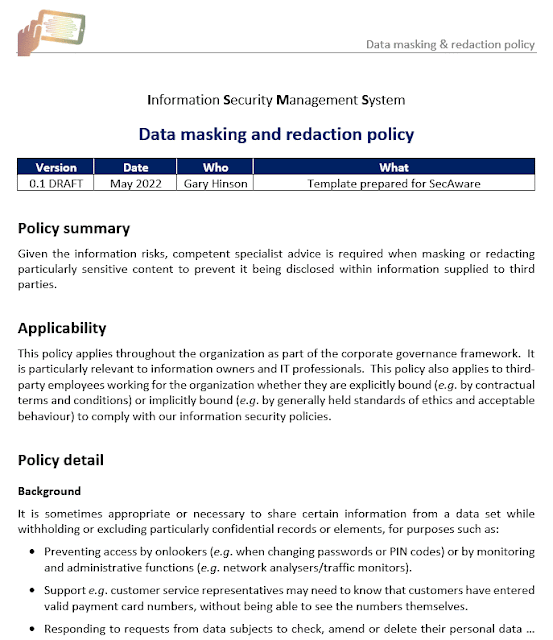
  Last evening I completed and published another SecAware infosec policy template addressing ISO/IEC 27002:2022 clause 8.11 "Data masking": "Data masking should be used in accordance with the organization’s topic-specific policy on access control and other related topic-specific, and business requirements, taking applicable legislation into consideration." The techniques for masking or redacting highly sensitive information from electronic and physical documents may appear quite straightforward. However, experience tells us the controls are error-prone and fragile: they generally fail-insecure, meaning that sensitive information is liable to be disclosed inappropriately. That. in turn, often leads to embarrassing and costly incidents with the possibility of prosecution and penalties for the organisation at fault, along with reputational damage and brand devaluation. The policy therefore takes a risk-based approach, outlining a range of masking and redaction controls...

Classification versus tagging

I'm not happy with the idea of 'levels' in many contexts, including information classification schemes. The term 'level' implies a stepped progression in one dimension. Information risk and security is more nuanced or fine-grained than that, and multidimensional too. The problems with 'levels' include: Boundary/borderline cases, when decisions about which level is appropriate are arbitrary but the implications can be significant;  Dynamics - something that is a medium level right now may turn into a high or a low at some future point, perhaps when certain event occurs;  Context e.g. determining the sensitivity of information for deliberate internal distribution is not the same as for unauthorized access, especially external leakage and legal discovery (think: internal email);  Dependencies and linkages e.g. an individual data point has more value as part of a time sequence or data set ...  ... and aggregation e.g. a structured and systematic compilation of p...

Navigable structures

Image
Some interesting suggestions concerning structures, content and management tools came up on CISSPforum yesterday as we chatted about security policies.  I mentioned before that I'm getting glimpses of structure within the policy suite. In fact, there are several structures, different ways to group, link and use them which complicates matters. It's a mesh of  multiple partially-overlapping categories, and a number of possible viewpoints reflecting  the perspectives and interests of the various users.  Much the same issue affects ISO/IEC 27002: numerous possible controls addressing a plethora of risks can be groups and arranged in several ways. At the same time the standard is aimed at a wide variety of people and organizations, with perspectives and needs that, by the way, aren't static but change as they get stuck in the subject and their interests develop. ISO/IEC JTC 1/SC 27 is tackling this issue by systematically 'tagging' the controls with labels, allowing user...

The periodic table of atomic controls [updated]

Image
Many information security controls are multi-purpose, hence they could be specified in several places, several policies plus procedures and standards and guidelines etc . That multiplicity creates a nightmare for the ISO/IEC JTC 1/SC 27 project team trying to generate a succinct version of ISO/IEC 27002 without duplications, gaps or discrepancies in the control catalog. It’s also a potential nightmare for anyone writing corporate policies, or an opportunity depending on how you deal with it.  My current pragmatic approach is to mention [hopefully] all the important controls in each topic-specific policy template, with a reference section that mentions other related policies, creating a kind of policy matrix. I’m still wary of gaps and discrepancies though: with 60+ policies in our matrix so far, it’s fast approaching the limit of my intellectual abilities and memory to keep them all aligned! It’s an ongoing task to review and revise/update the policy templates, without breaking li...

Database security awareness

Image
Generally speaking, our most important IT systems are databases. Aside from the obvious - and business critical - corporate databases such as the General Ledger and Customer Database, other examples are myriad lists, inventories and semi-structured information collections, some of which are not even computerized. Phone books and contact lists on cellphones and tablets are databases, while many of us maintain databases of documents, spreadsheets and other files in the cloud. Speaking personally, my to-do list scribbled on a handy scrap of paper is an important reminder for me: if I lose it, it’s hard for me to recall what was on it, so to some degree information security is important even for that!

Awareness module on surveillance

Image
Prompted by recent revelations about mass surveillance by the NSA, we wrote a new awareness module covering the information security issues relating to surveillance from two distinct perspectives:  Surveillance conducted by the organization on its employees and others; Surveillance conducted on the organization by the authorities and others. We interpret 'surveillance' liberally to include activities such as monitoring employees' use of email, the networks, applications and the phones.  Surveillance is generally a side effect, not usually the main purpose of ICT monitoring, but nevertheless myriad system and network managers and security professionals have the data and the tools to analyze what users are up to and often where they are.   CCTV is an everyday example of surveillance, and again the security pros watching those TV screens inevitably see lots of ordinary people quietly going about their lives, not just criminals, intruders, vandals, shoplifters and so on. Cutt...

Molds and parasites - new families of malware

Image
The following paragraph remains unredacted in a heavily redacted NSA newsletter from 1996 : "The most harmful computer virus will not be the one that stops your computer, but the one that randomly changes or corrupts your data over time." Malware that causes data corruption perhaps ought to be called a fungus or mold rather than a virus but I guess "virus" remains the nondescript all-purpose term preferred by journalists and lay-people alike.  Anyway, I partially agree with the statement. Compared to incidents that are as crude and noisy as completely stopping the computer, more sophisticated and silent attacks (such as those behind APTs - Advanced Persistent Threats) are more dangerous and insidious because they can continue unabated for longer.  As with a parasite that exploits its symbiotic relationship with the host, a lengthy infection starts off with the host barely even recognizing that it has been victimized. Random data corruption is a concern, for sure, bu...

Another 4,900,000 privacy breach statistics

A backup tape containing medical records and other personal information on nearly 5 million US military personnel in the TRICARE scheme has been stolen from an SAIC employee's car.  TRICARE is a US " health care program serving Uniformed Service members, retirees and their families worldwide". SAIC ( S cience A pplications I nternational C orporation) is a "scientific, engineering, and technology applications company that uses its deep domain knowledge to solve problems of vital importance to the nation and the world, in national security, energy and the environment, critical infrastructure, and health. We do this with the constant and deliberate commitment to ethical performance and integrity that has marked SAIC since its founding".  It is best known as an IT oursourcer/service provider. TRICARE's statement "retrieving the data on the tapes would require knowledge of and access to specific hardware and software and knowledge of the system an...

Amazon cloud incident a lesson in resilience and forensics

Amazon's EC2 cloud computing service suffered a serious incident on April 21st.  Given that it affected several customers using its EBS (Elastic Book Store) service, Amazon could hardly deny it and has now published an interesting paper explaining what went wrong . The original trigger was a leeeetle mistake when reconfiguring network connectivity for some planned work.  Primary network traffic was redirected to a network with inadequate capacity, resulting in the servers losing the vital network connections they need to remain in synch as part of a cluster.  This in turn triggered the servers to try to re-synch, which exacerbated the network performance constraint until the house of cards fell. It caught my eye that Amazon's cloud-based relational database service was impacted by the incident: "In addition to the direct effect this EBS issue had on EC2 instances, it also impacted the Relational Database Service (“RDS”). RDS depends upon EBS for database and log storag...

The world didn't stop for Sony

Another news story of yet another privacy breach at Sony includes a handy timeline of their known breaches stretching back to mid-April. The latest incident involved 8,500 user accounts at a Sony music site in Greece, which means its another database breach, which is what makes it newsworthy (along with the fact that it was Sony, of course). Sony is a huge company with information assets all over the world.  Many of them are customer-facing, but many more are internal.  Sony is renowned for its business model of 'creating categories', in other words it constantly innovates, creating and launching hi-tech products aimed at satisfying previously unrecognized and untapped demand, and by the time the market category is wound up to speed, it moves on. Perhaps we'll soon see the Sony Database Security Station hit the streets?

Database security survey

Despite the headline stories about database hacks and privacy exposures, a survey of database users found that respondents particularly feared insider threats.  Many such attacks go unreported - in fact I strongly suspect many more go unrecognized.

Sony incident - yet more

Gene Spafford has told a congressional hearing that, months before the incident, Sony knew it was running old and unpatched software on its web servers ... implying that they were negligent in not patching or updating to address known security vulnerabilities.  It's not quite so cut-n-dried in practice however as patching/updating production services is itself a risky business (not least because the patched/updated software may have yet more security vulnerabilities). Sony evidently had other/compensating controls in place, since they at least detected the latest breach through their network security monitoring. Unfortunately, this happened too late to stop the hacker/s extracting personal information probably including credit card numbers.

LastPass database compromised

Brian Krebs' excellent blog alerted me to a probable database compromise at LastPass.com LastPass.com ("The last password you'll have to remember!") is an online database or vault for users' passwords and other confidential user information.  Naturally the user information is encrypted, using a 'master password' and a salt to generate the cryptographic key.  It appears that hackers may have broken the site's security to access and steal encrypted data from the database, possibly including the salts.  They are presumably hard at work brute-forcing those master passwords right now, so the race is on for users of LastPass to login and change their master passwords before the crackers access all their stored data - and then go on a rampage though users' accounts on other systems using the stored passwords. This is exactly the kind of compromise that sites such as LastPass seek to avoid at all costs.  They do so through a process of examining their in...

Sony incident - more

According to the LA Times, Sony has now confirmed that 10 million credit card numbers may have been stolen in the PlayStation network hack.  The credit card numbers were evidently hashed rather than encrypted, which is potentially a good thing.  A strong hashing scheme works like a bit like a non-return valve:credit card numbers feed in at one end, are processed through an algorithm into a hash value, and that gets stored on disk.  However, there is [almost] no way to push the hash value backwards through the algorithm to regenerate the credit card number.  If they had been encrypted, the crypto key would have unlocked all 10 million card numbers. Hashing is normally used for passwords.  Having initially created and stored a hash of someone's password, the next time they login, the password they present is hashed in the same way and the hash values are compared for a match, indicating that the original password (or, strictly speaking, a password that gave the s...

Security firm's database hacked

According to The Register : "Try this for irony: The website of web application security provider Barracuda Networks has sustained an attack that appears to have exposed sensitive data concerning the company's partners and employee login credentials, according to an anonymous post." Barracuda's own application firewall appliance was offline for maintenance at the time, and hence failed to block the SQL injection attack. "Bugger" said Barracuda's management.

Sony database security incident - a hot awareness topic

Image
Anyone who has seen the huge furore in the press and the blogoshpere over the Sony PlayStation hack will surely agree that database security is a hot topic right now, so it's timely for us to release a thoroughly updated, revised and expanded awareness module on database security . We've used the Sony incident as a topical case study to illustrate the materials. We're hoping that customers will use the materials straight away, helping their employees make the link between the news coverage, their own privacy, and the privacy of other people whose personal information they may well be handling at work.

SQL as an audit tool

Mike Blakley wrote a fine piece in EDPACS on using SQL queries to interrogate a database system for audit purposes. Abstract: "Organizations, both large and small, are increasingly reliant on database systems for their operational support needs. This is due to the adoption of accounting systems ranging from large enterprise resource planning systems, down to departmental or even desktop-based database systems. The traditional audit approach used to account for data stored in databases has relied on information technology or other support staff to extract data for audit, which was then tested by others, often technical specialists. An alternative approach, which also provides greater audit independence, is to increase the knowledge level and skills of audit staff so they can obtain this data directly and perform their audit tests independently. This article may have relevance to other IT system audits." In the same issue, Fred Cohen discusses the specification of control requi...

Computer-aided retail fraud

A 46-page academic paper by Richard Thompson Ainsworth of Boston University School of Law describes "zappers" - programs designed to divert some sales transactions from the normal sales processing and accounting systems. Fraudsters with sufficient access to an organization's sales systems (e.g. small business owners) sometimes use zappers either to misappopriate the entire sales income for the diverted sales (steal the entire value from the company - the sales don't go through the books) or to to manipulate the value (for example to steal the VAT/GST/sales tax content). So-called "zap" and "super-zap" programs have existed for decades in the mainframe world. They allow intervention on databases, overriding normal access constraints to manipulate the data, and potentially programs, directly. They are supposed to be used only under carefully controlled emergency conditions, for instance to modify or delete a rogue data record that is somehow bloc...