Posts

Showing posts with the label IoT

New ISO27k domotics security standard

Image
ISO/IEC 27403 " Cybersecurity – IoT security and privacy – Guidelines for IoT-domotics " was published at the very end of last month. “Domotics” is a neologism for smart homes. This  new   standard  covers the cybersecurity and privacy aspects of thing -to- thing interactions ( e.g. home hubs and entertainment subsystems) as well as human-to- thing  plus  thing -to-sensors/actuators that physically interact with the home ( e.g . smart door locks and thermostats) and networking both within the home ( e.g . WiFi, Bluetooth) and beyond ( e.g . fibre or wireless broadband). The  standard  is aimed squarely at guiding the designers, manufacturers and security or privacy assessors of IoT domotics, as oppoed to retail customers and users. It provides examples of information risks that should (in theory at least) have been identified, evaluated and addressed by IoT suppliers baking-in suitable security controls to protect their valued customers' interests. I...

Skyscraper of cards

Image
Having put it off for far too long, I'm belatedly trying to catch up with some standards work in the area of R oot o f T rust, which for me meant starting with the basics, studying simple introductory articles about RoT. As far as I can tell so far, RoT is a concept -  the logical basis, the foundation on which secure IT systems are built. 'Secure IT systems' covers a huge range. At the high end are those used for national security and defence purposes, plus safety- and business-critical systems facing enormous risks (substantial threats and impacts). At the low end are systems where the threats are mostly accidental and the impacts negligible - perhaps mildly annoying. Not being able to tell precisely how many steps you've taken today, or being unable to read this blog, is hardly going to stop the Earth spinning on its axis. In fact' mildly' may be overstating it. 'Systems' may be servers, desktops, portables and wearables, plus IoT things and all mann...

ISO/IEC 27400 IoT security and privacy standard published

Image
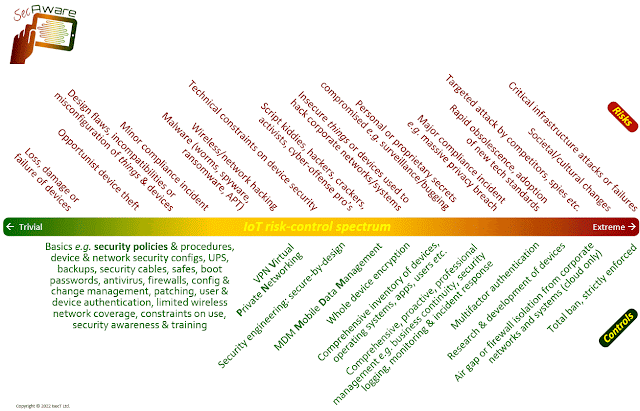
To celebrate the publication of ISO/IEC 27400:2022 today, we have slashed the price for our IoT security policy templates to just $10 each through SecAware.com. IoT policy is the first of the basic security controls shown on the 'risk-control spectrum' diagram above, and is Control-01 in the new standard ... Do you have a security policy on IoT? If not, does that mean IoT is out of control in your organisation? Even if you do, what does it say? Is it valid, appropriate, worthwhile, sufficient?   The spectrum diagram shows quite a variety of risks and controls, but it is merely a summary, selected highlights. Attempting to cover them all in a policy document would be counterproductive - in fact, general employees can barely cope with a much-simplified one-page 'acceptable use policy'.   The new ISO/IEC 27400 standard takes a broad perspective with copious advice on information security and privacy for the designers, manufacturers, purchasers, users and administrators o...

Domotics - a can-o-worms

Image
This morning, I’ve been browsing and thinking about ISO/IEC 27403 , a draft ISO27k standard on the infosec and privacy aspects of “domotics” i.e. IoT things at home.   Compared to a [reasonably well controlled] corporate situation, there are numerous ‘challenges’ (risks) in the home setting e.g.: Limited information security awareness and competence by most people. IoT things are generally just black-boxes. Ad hoc assemblages of networked IT systems - including things worn/carried about the person (residents and visitors) and work things, not just things physically installed about the home (e.g. smart heating controls, door locks and cat feeders). Things are not [always] designed for adequate security or privacy since other requirements (such as low price and ease of use) generally take precedence. Finite processing and storage capacities, plus limited user interfaces, hamper/constrain their security capabilities. Lack of processes for mana...

ISO/IEC 27002 update

Image
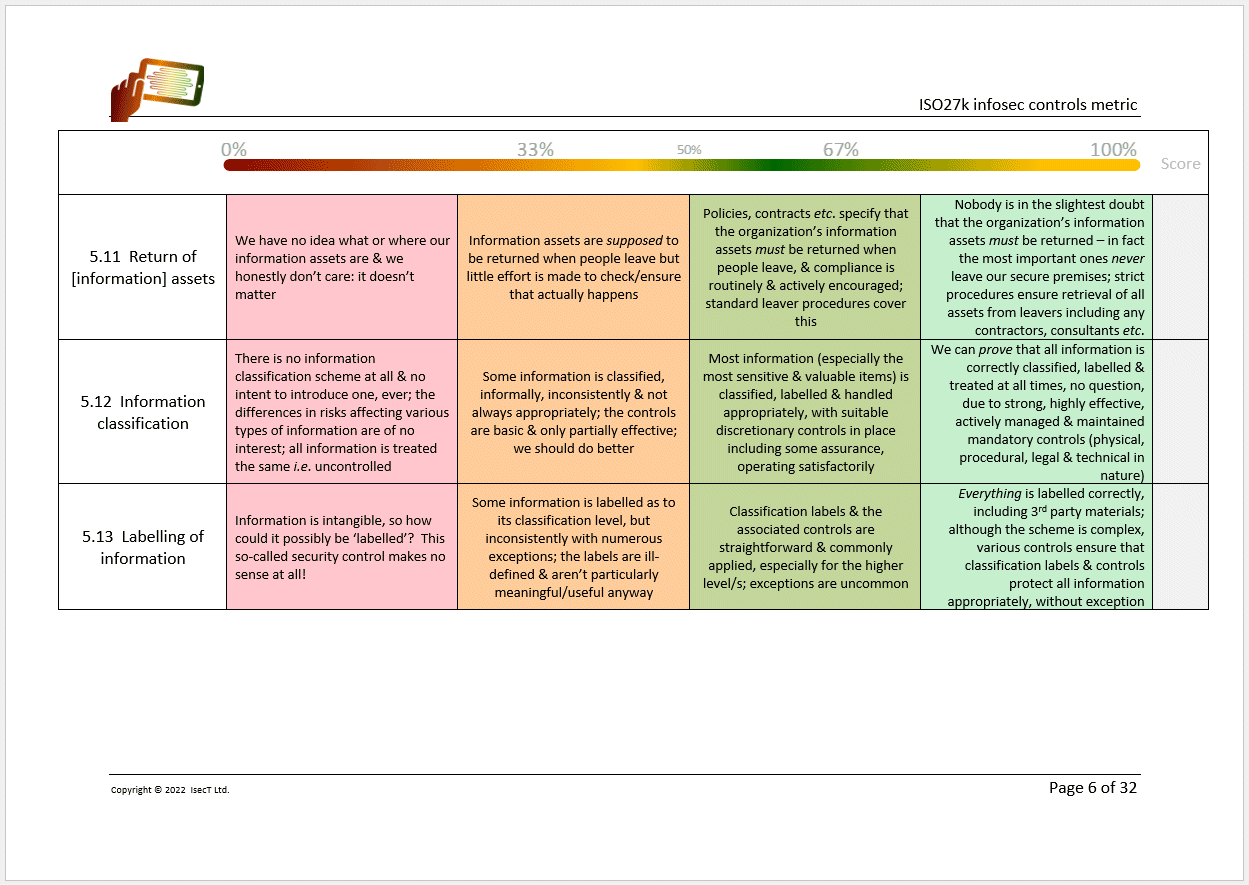
The newly-published third edition of ISO/IEC 27002 is a welcome update to the primary ISO27k controls catalogue (officially, a 'reference set of generic information security controls').  Aside from restructuring and generally updating the controls from the 2013 second edition, the committee (finally!) seized the opportunity to beef-up the coverage of information security for cloud computing with new control 5.23, plus ten other new controls, mostly in section 8 (technological controls):   Configuration management (8.9) - concerns the need to manage security and other configuration details for [IT] hardware, software, [information] services and networks. Data leakage prevention (8.12) - DLP is required to protect sensitive information against unauthorized disclosure/extraction (theft, surveillance). Data masking (8.11) - in line with the organisation’s access control policy, plus other business requirements and compliance obligations, scurity controls are apropriate to mitig...

Weaving strategies with policies

Image
I mentioned recently here on the blog that there can be strategic elements to policies, just as there are operational aspects to the supporting procedures and guidelines. With the new year fast approaching, I'd like to explore that further today. Warning : your blinkers are coming off. Prepare for the glare. Take for instance the corporate responses to COVID-19. Out of necessity, organisations in lockdown shifted rapidly from on-site office work and in-person meetings to home-working, using video conferencing, email and collaborative approaches. Although that may have been a purely reactive, un-pre-planned response to the global crisis that erupted (despite prior pandemics and warnings arising from increasing international travel) , it was facilitated by longer-term planned, strategic changes and investments in a resilient workforce with flexible working practices and positive attitudes, strong relationships within and without the organisation, plus appropriate tools and technolog...

Stepping on the cracks

Image
Anyone seeking  information security standards or guidance is spoilt for choice e.g. : ISO27k - produced by a large international committee of subject matter experts and national representatives   NIST SP 800 series – well researched, well written, actively maintained ... and FREE! IT Grundschutz - a typically thorough Germanic approach, to the point of absurdity (4,800 pages!  It's encyclopaedic!)    CSA - cloud security guidance is their home turf COBIT - takes a deliberately different perspective on 'risk' and 'control'   Secure application development standards such as those from  OWASP   IT standards and methods as a whole : relevant because IT or cyber security is clearly a big part of information security   HR, physical security, privacy and business continuity standards and methods as a whole : filling-in the substantial gaps in IT or cyber security  Risk management standards , the best of which at least mention the im...

News on ISO/IEC 27002

Image
Today I’ve slogged my way through a stack of ~50 ISO/IEC JTC1/SC27 emails, updating a few ISO27001security.com pages here and there on ongoing standards activities. The most significant thing to report is that the project to revise the 3 rd  (2013) edition of ISO/IEC 27002 appears on-track to reach final draft stage soon and will hopefully be approved this year, then published soon after (during 2022, I guess).    The standard is being extensively restructured and updated, collating and addressing about 300 pages of comments from the national standards bodies at every stage.  The editorial team are doing an amazing job!   The new ‘27002 structure will have the controls divided into 4 broad categories or types i.e.  technical, physical, people and ‘organizational’ [=other]: For comparison, the standard is currently structured into 13 security domains: ‘27002 will nearly double in size, going from 90 to 160 pages or so, thanks to new controls and...

Y2k + 20: risk, COVID and "the Internet issue"

Image
It feels like 'just the other day' to me but do you recall "Y2k" and all that?  Some of you reading this weren't even born back then, so here's a brief, biased and somewhat cynical recap. For a long time prior to the year 2000, a significant number of software programmers had taken the same shortcut we all did  back in "the 90s". Year values were often coded with just two decimal digits: 97, 98, 99 ... then 00, "coming ready or not!". "Oh Oh" you could say. "OOps". When year counters went around the clock and reset to zero, simplistic arithmetic operations (such as calculating when something last happened, or should next occur) would fail causing ... well, potentially causing issues, in some cases far more significant than others. Failing coke can dispensers and the appropriately-named Hornby Dublo train sets we could have coped with but, trust me, you wouldn't want your heart pacemaker, new fangled fly-by-wire plan...